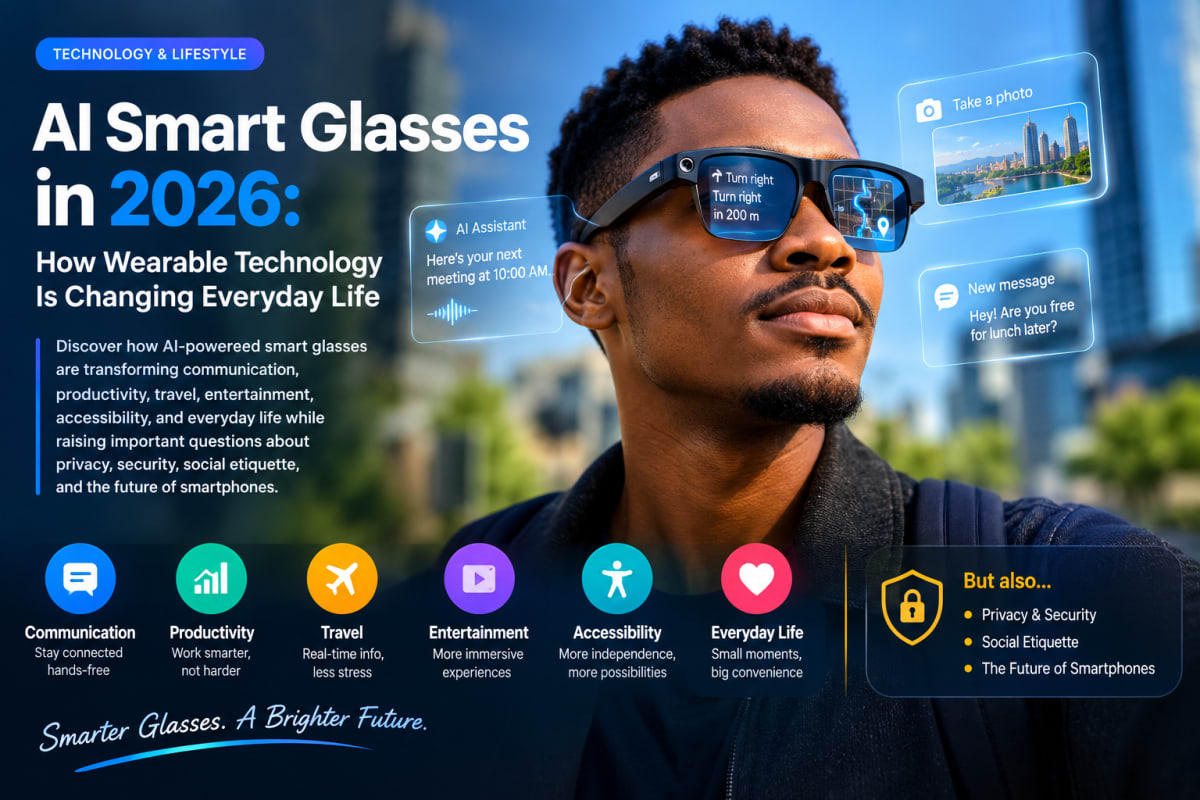
AI Smart Glasses in 2026: How Wearable Technology Is Changing Everyday Life
Smart glasses have been "the next big thing" for over a decade. Google Glass arrived in 2013, dazzled early adopters, and then quietly retreated into enterprise use. Snap tried again with Spectacles. Neither cracked mainstream consumer adoption. The technology was ahead of the habits, and the glasses looked like technology rather than something you would actually want to wear.
In 2026, something has shifted. AI smart glasses — eyewear that combines cameras, microphones, speakers, and AI assistants into frames that look like normal glasses — are moving from novelty to practical tool. Meta's Ray-Ban and Oakley collaborations have sold millions of pairs. Global shipments of AI glasses reached 4.2 million units in the first half of 2026 alone, more than double the same period last year . The category is no longer experimental.
The central question is whether this is a genuine shift in how people interact with technology, or another gadget that will gather dust in a drawer. The answer depends less on the technology itself and more on whether it solves problems people actually have — and whether society can resolve the privacy tensions it creates.
What Are AI Smart Glasses?
AI smart glasses are wearable devices that embed cameras, microphones, speakers, and an AI assistant into conventional eyewear frames. They look like glasses — sometimes indistinguishable from a standard pair — but function as a hands-free computer.
The components vary by model, but most current AI glasses include a camera for capturing photos and video, microphones for voice commands and calls, open-ear speakers that project sound toward the wearer without blocking ambient noise, Bluetooth connectivity to a smartphone, and access to a cloud-based AI assistant. Some models, like those from Even Realities, add a small monochrome display that can show notifications, transcripts, or navigation cues .
It helps to distinguish the categories. Traditional glasses correct vision. Basic smart glasses might add audio playback without AI. Camera-equipped smart glasses can capture photos and video but rely on you to decide what to do with them. AI smart glasses add an assistant that can understand what you are looking at, answer questions about it, translate text, and perform tasks on your behalf. Augmented reality glasses go further still, overlaying digital information onto your field of view.
Most AI glasses available today are not true AR devices. They augment your capabilities with audio and AI, not with visual overlays.
How AI Smart Glasses Work
A typical interaction is straightforward. You tap a button or say a wake phrase. The glasses capture your voice or a image through their camera. That data goes to an AI model — sometimes on the device, often in the cloud — which interprets what you are asking. The response comes back through the speakers, or in some models, appears on a small display.
Practical examples of what current AI glasses can do include asking what building you are looking at, translating a sign or menu in a foreign language, taking a photo hands-free, setting a reminder based on what you see, reading product labels aloud, getting turn-by-turn directions through audio, and asking the AI to summarize or describe what is in front of you .
More advanced capabilities — like real-time translation of an ongoing conversation, or AI that proactively offers information based on context — are emerging but not universally reliable. The gap between what is demonstrated on stage and what works consistently in daily life remains significant.
AI Smart Glasses vs Smartphones
The comparison with smartphones is inevitable, but the framing matters. Smart glasses are not trying to be phones. They are trying to be something phones are bad at: hands-free, contextual, always available without requiring you to pull a device from your pocket.
Factor Smartphone AI Smart Glasses Interaction Screen, touch, typing Voice, limited touch, some displays Cameras High-quality, multiple lenses Point-of-view, lower resolution Portability Pocket-sized, needs handling Worn on face, always available Battery life All-day with heavy use 4–9 hours typical, charging case extends App ecosystem Millions of apps Limited, growing Privacy Obvious when in use Covert recording possible AI assistance Available but requires device interaction Hands-free, contextualSmart glasses complement phones in the near term. They handle quick tasks — taking a photo, asking a question, getting directions — without the friction of unlocking a screen. For anything requiring sustained attention, typing, or complex apps, the phone remains better. The glasses reduce how often you need to reach for it, but they do not eliminate the need.
What Can People Actually Do With AI Smart Glasses?
The practical applications span several areas of daily life.
Communication is the most immediately useful function. Hands-free calls, voice messages, and notifications delivered through open-ear speakers mean you stay connected without looking at a screen. For anyone who has tried to take a call while carrying groceries or walking through a city, the value is obvious.
Travel benefits from translation, navigation, and the ability to identify landmarks or read signs in unfamiliar languages. Meta's glasses now support real-time translation across 14 additional languages . For travelers, this is more than convenience — it removes a layer of friction from navigating foreign environments.
Learning happens naturally when you can ask questions about what you see. Reading assistance, visual explanations, and language practice all become easier when the AI can see what you are looking at.
Content creation is a major draw. First-person photos and videos, captured hands-free, offer a perspective that phones cannot easily replicate. For travelers, athletes, and creators, this is genuinely new capability.
Accessibility may be the most transformative application. For people with vision loss, AI glasses can describe surroundings, identify objects, recognize people, and read text aloud. ProVision Sight Africa, a Kenyan organization, has built smart glasses specifically for visually impaired users that work offline and recognize local touchstones, with Swahili, Kikuyu, and Luo language support in development .
AI Smart Glasses for Work and Business
Professional environments are where the value proposition becomes clearer. Field technicians can access manuals and receive remote guidance without putting down tools. Delivery workers can get hands-free navigation and confirmation. Retail staff can look up inventory or product information while assisting customers. Healthcare workers can access patient information without touching a device.
The common thread is reducing the need to stop what you are doing to interact with a screen. For workers whose hands are occupied or whose attention needs to stay on a physical task, this matters.
Workplace deployment, however, requires clear policies. Recording in customer-facing or sensitive environments raises consent and privacy questions that businesses must address before handing glasses to employees. The technology enables productivity gains, but only if deployed thoughtfully.
The Privacy Problem
This is the issue that will determine whether AI smart glasses achieve mainstream adoption or remain a niche product.
Smart glasses create privacy concerns that smartphones do not. A phone camera is obvious when raised. Glasses with cameras can record discreetly, and bystanders may not know they are being captured. The LED indicator light that Meta includes can be physically disabled with third-party modifications for as little as $60 .
The distinction between what the wearer chooses to record and what the device may be capable of observing is important. A user might never intend to record a private conversation, but the device is always listening for voice commands. False activations — when the glasses mishear something as a wake phrase — can capture audio the wearer did not intend to share .
In 2026, these concerns moved from theoretical to regulatory. Norway's government proposed a temporary ban on smart glasses in places where privacy is particularly important: healthcare facilities, changing rooms, schools, kindergartens, and playgrounds . California's governor vetoed legislation that would have penalized covert recording in sensitive spaces . In France, a child welfare group reported cases of women being filmed without consent, with footage shared online .
Kenya has been directly affected. In early 2026, a Russian vlogger used Ray-Ban Meta glasses to record intimate encounters with women without their knowledge and posted the footage online. The Office of the Data Protection Commissioner launched an investigation, and the case highlighted how existing regulations struggle to address wearable cameras . Under Kenya's Data Protection Act, the ODPC has issued compensation orders for unauthorized image use, but enforcement against foreign device users is complex .
AI smart glasses do not just record what the wearer chooses. They process what the device sees and hears, often in the cloud, often reviewed by human contractors. The person standing nearby has no way to know which category they fall into.
Investigations revealed that footage from Meta glasses was being routed to human reviewers — including intimate moments, banking details, and private domestic scenes. Workers in Nairobi described seeing "everything" during 10-hour shifts annotating the data . This is the hidden labor behind AI features that feel effortless to the user.
Smart Glasses and Social Etiquette
Technology adoption is influenced by social norms as much as technical capability. The rules around smart glasses are still forming.
Reasonable guidelines are emerging. Ask before recording people in private or sensitive situations. Avoid recording where privacy is expected — restrooms, changing rooms, medical settings. Respect venue policies; many cinemas, gyms, and schools now restrict camera-equipped glasses . Be transparent when recording is relevant to the interaction. Do not use AI features to identify or surveil people without consent.
The awkwardness is unavoidable in the near term. People are still getting used to the idea that someone nearby might be recording. The LED indicator helps, but it can be missed or disabled. Social trust will take time to develop, and it may never fully arrive for certain contexts.
Security Risks
Smart glasses are connected devices, and they carry the same security risks as any connected device — with higher stakes because they are worn on your face.
Compromised accounts can expose recordings and location data. Unpatched firmware vulnerabilities can allow unauthorized access to the camera and microphone . Malicious companion apps or Wi-Fi hotspots can intercept data. Weak passwords and lack of multi-factor authentication increase the risk of account takeover.
Practical security measures are straightforward. Use strong passwords and enable multi-factor authentication. Keep firmware and companion apps updated. Review what data the glasses collect and where it is processed. Understand that AI features often require cloud connectivity, which means your data leaves the device. For sensitive conversations, consider whether wearing the glasses is appropriate at all .
The Battery and Connectivity Problem
Real-world usability depends on boring factors. Battery life on most AI glasses ranges from 4 to 9 hours of active use, with charging cases extending total runtime . Heavy camera or AI use drains faster. If you forget to charge, you lose the smart features and are left with — at best — audio glasses.
Most AI glasses depend on a paired smartphone for internet connectivity and some processing. Without the phone nearby, functionality is limited. Without internet, AI features stop working entirely. This dependency means the glasses are an accessory, not a replacement.
Comfort matters more than specifications. A 40-gram pair of glasses feels different after eight hours than it does in a showroom. Frame fit, lens options, and weight distribution determine whether you actually wear them daily.
Are AI Smart Glasses Actually the Future?
The trajectory is promising, but adoption is not guaranteed.
Previous attempts at smart glasses failed partly because they looked like technology rather than eyewear. People did not want to wear something that screamed "I am a gadget." Current models from Meta, Ray-Ban, and others have closed that gap. They look like glasses because they are made by eyewear companies, not just tech companies .
AI may be the missing piece that makes wearable technology genuinely useful rather than just novel. The ability to ask questions about what you see, translate in real time, and get contextual assistance addresses real friction points in daily life. But the privacy concerns are not minor, and they are driving regulatory responses that could limit where the devices can be used.
The outcome will depend on whether the industry can build trust. That means transparent data practices, meaningful recording indicators that cannot be disabled, clear consent mechanisms, and respect for social norms. Without trust, adoption will stall at early adopters.
AI Smart Glasses and Daily Life in Kenya
For Kenyan consumers, the practical considerations are different from early adopters in the US or Europe. Ray-Ban Meta glasses are available locally, with prices starting around 57,000 Kenyan Shillings for the Gen 2 Headliner model . That is a significant purchase for most buyers.
The potential applications are real. Translation between English and Kiswahili, navigation in unfamiliar towns, field work in agriculture or construction, and hands-free communication for small business operators are all plausible use cases. ProVision Sight Africa has already demonstrated how smart glasses can transform accessibility for visually impaired users, with offline functionality designed for environments where connectivity is unreliable .
Challenges remain. Device pricing puts them out of reach for many. Mobile data costs add ongoing expense. Repair and support infrastructure is limited. Local language support is still developing. And the privacy incident involving a foreign vlogger using Meta glasses to film women without consent has raised legitimate concerns about how the technology could be misused .
How to Choose AI Smart Glasses
A practical buyer's checklist should prioritize function over marketing.
- AI capabilities: What can the assistant actually do reliably? Test before buying if possible.
- Camera quality: Resolution matters less than usability in real conditions.
- Audio quality: Open-ear speakers should be clear without leaking sound to others.
- Battery life: Match to your actual usage patterns, not best-case specs.
- Comfort: Weight and fit determine whether you wear them daily.
- Privacy controls: Recording indicators, data policies, and whether features can work offline.
- Compatibility: Does it work with your phone? Are apps available in your region?
- Warranty and repair: Can you get them fixed locally?
- Price: Consider total cost, not just the device.
Do not buy based on AI marketing claims. The gap between demo and daily use is real.
Should You Buy AI Smart Glasses in 2026?
The answer depends on who you are.
You may benefit most if you are a content creator who values first-person capture, a traveler who frequently navigates unfamiliar places, someone with accessibility needs that voice-controlled assistance addresses, or a professional whose work involves hands-free information access.
You may want to wait if you primarily want normal glasses, are uncomfortable with cameras and microphones in your daily environment, live somewhere with unreliable internet or expensive data, or expect the glasses to replace your phone.
The technology is real and useful. It is also early, imperfect, and raising unresolved questions about privacy and social norms.
The Future of Wearable AI
Several trends are emerging, though it is worth distinguishing what exists from what is predicted.
Better on-device AI processing is reducing dependence on cloud connectivity, which improves speed and privacy . Real-time translation is expanding to more languages. Computer vision is improving, enabling richer understanding of what the glasses see. Displays are becoming smaller and more energy-efficient.
The bigger shift may be from reactive to contextual. Today, you ask the glasses a question. Tomorrow, they might offer relevant information based on what you are doing and where you are — a subtle but significant change in how technology supports daily life. AI agents that operate through wearable devices, coordinating tasks across services, are an emerging possibility, though current implementations are limited .
These developments are not guaranteed. They are directions the technology is moving, with no certainty about how quickly or how well they will work.
Risks of Over-Reliance on Wearable AI
Every technology that makes something easier also creates the risk of dependence. Smart glasses are no exception.
Reduced awareness of surroundings is a real concern. If you are constantly interacting with an AI through your glasses, you may miss what is happening around you. Constant notifications, delivered directly to your ears, can fragment attention. Privacy fatigue — the exhaustion of constantly monitoring what is being recorded and where data goes — may lead some users to simply stop caring.
There is also the risk of AI providing incorrect information confidently. If you are relying on the glasses to translate a sign or identify a building, errors matter. The technology should enhance your judgment, not replace it.
Conclusion
AI smart glasses represent a meaningful shift toward more natural, hands-free computing. They move technology from the screen you have to look at to the world you are already looking at. For tasks where your hands are busy, your eyes are elsewhere, or your phone is inconvenient, they offer genuine value.
But their success depends on more than cameras and AI models. Consumers will care about trust, privacy, battery life, comfort, and whether the glasses actually solve problems they have. The regulatory pushback in Norway, the privacy incidents in Kenya and France, and the ethical questions about data annotation all signal that society is still negotiating the terms of this technology.
The future of computing may not be about carrying more screens. It may be about making technology available when you need it, in a form that disappears into your daily life. Whether AI smart glasses become that technology depends on whether the industry can earn the trust that makes people comfortable wearing cameras on their faces.
Frequently Asked Questions
What are AI smart glasses?
AI smart glasses are wearable devices that look like normal glasses but contain cameras, microphones, speakers, and an AI assistant. They allow hands-free photo capture, voice commands, translation, and access to AI-powered information without requiring a phone screen.
What can AI smart glasses do?
Current capabilities include taking photos and videos hands-free, making calls, listening to music or podcasts, asking an AI questions about what you see, translating text and conversations, getting audio navigation, and setting reminders. Some models include small displays for notifications or transcripts.
Are AI smart glasses better than smartphones?
They serve different purposes. Smart glasses are better for hands-free, quick interactions and point-of-view capture. Smartphones are better for complex tasks, typing, and running full applications. Most users will carry both rather than replacing one with the other.
Can AI smart glasses record people?
Yes. Most AI glasses include cameras capable of photo and video recording. Some jurisdictions are moving to restrict recording in sensitive locations, and social norms around consent are still developing. Bystanders may not always know they are being recorded.
Are AI smart glasses safe for privacy?
They raise privacy concerns that smartphones do not, primarily because recording can be discreet. Users should understand what data is collected, where it is processed, and how it is stored. Bystanders have limited ability to know if they are being recorded or how their data is handled.
Can AI smart glasses work without a phone?
Most current models require a paired smartphone for internet connectivity, some processing, and app access. Without the phone nearby, functionality is typically limited to basic audio playback and offline features.
Are AI smart glasses useful for everyday life?
For some users, yes. They are most useful for hands-free tasks, quick information lookup, travel assistance, and content capture. For others, the benefits may not justify the cost and privacy tradeoffs.
Should I buy AI smart glasses in 2026?
Consider your specific needs. If you value hands-free capture, travel assistance, or accessibility features, they may be worth it. If you primarily want normal glasses or are uncomfortable with cameras and microphones in daily life, waiting may be sensible. The technology is improving rapidly, but it is still early.