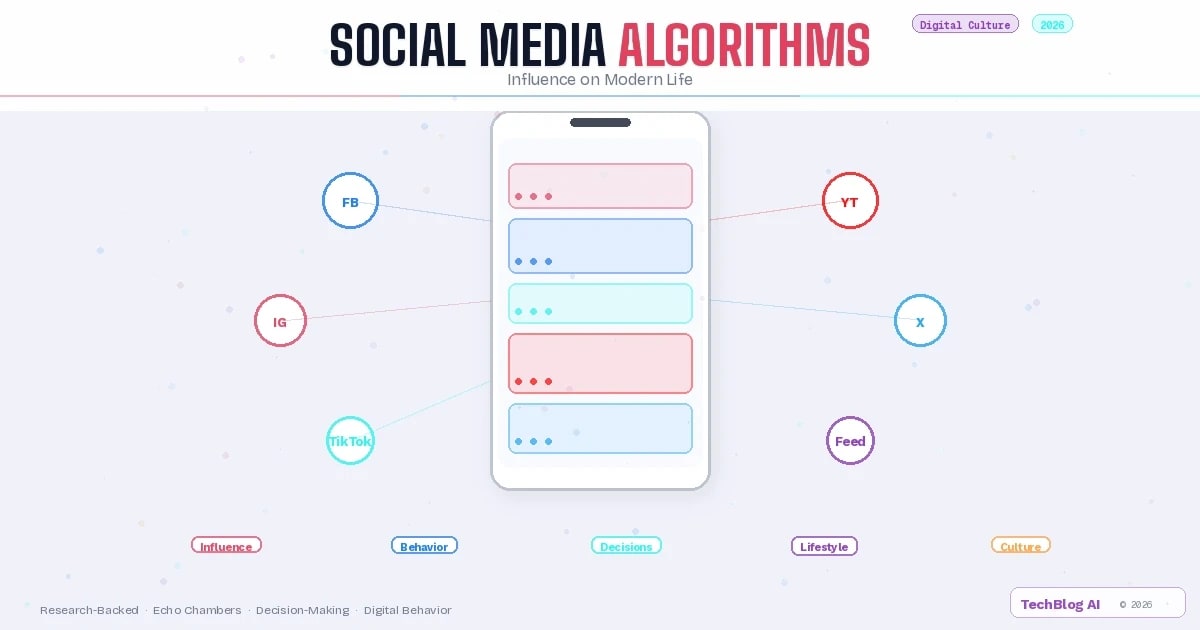
How Social Media Algorithms Influence Modern Lifestyles and Decisions
Quick Answer: Social media algorithms are decision-making systems that determine what content billions of users see daily. These algorithms influence lifestyle choices, purchasing decisions, political views, and social behaviors by personalizing content feeds based on past behavior, predicted interests, and engagement patterns. While they enable content discovery and connection, they also create echo chambers, reinforce biases, and can manipulate decision-making in ways users rarely recognize.
Every time you scroll through Instagram, watch videos on TikTok, or check your Facebook feed, an algorithm is making decisions about what you see. These invisible gatekeepers shape your information diet more powerfully than any newspaper editor or television producer ever could. They determine which news stories reach you, which products appear in your shopping feeds, which political messages you encounter, and even which friends' posts you see. For billions of people worldwide, social media algorithms have become the primary lens through which they experience information, culture, and connection.
The influence of these algorithms extends far beyond digital spaces. They shape fashion trends, music preferences, political beliefs, purchasing decisions, and daily routines. A recommendation algorithm might introduce you to a new hobby that becomes central to your identity. A content filtering system might gradually shift your political views by controlling what news you encounter. A personalization engine might influence where you vacation, what you eat, or how you spend your free time. These effects are not hypothetical; they are documented, measurable, and increasingly understood by researchers studying digital behavior.
This article examines how social media algorithms function, the mechanisms through which they influence individual and collective behavior, and the broader implications for society. Drawing on academic research, industry reports, and real-world case studies, we explore both the benefits and risks of algorithm-driven social media, providing a comprehensive understanding of one of the most consequential but least visible forces shaping modern life.
Understanding Social Media Algorithms
What Are Social Media Algorithms?
Social media algorithms are computational systems that automatically determine what content appears in users' feeds, in what order, and with what prominence. Unlike chronological feeds that simply display posts in time order, algorithmic feeds use complex mathematical models to predict what content each individual user will find most engaging, valuable, or relevant. These predictions are based on vast amounts of data about user behavior, preferences, and patterns.
At their core, these algorithms solve a fundamental problem: too much content exists for any user to see it all. Facebook users could theoretically view thousands of posts per day from friends, pages, and groups they follow. YouTube hosts more than 500 hours of video uploaded every minute. TikTok's content library is effectively infinite. Algorithms filter this overwhelming volume down to a manageable, personalized selection designed to maximize user engagement and satisfaction (Bakshy, Messing, & Adamic, 2015).
Types of Algorithmic Systems
Recommendation Algorithms suggest content users have not explicitly requested but might enjoy based on their history and similar users' behavior. YouTube's recommendation engine, which drives over 70% of watch time on the platform, exemplifies this category (Covington, Adams, & Sargin, 2016). These systems analyze viewing history, search behavior, and engagement patterns to predict what videos will keep users watching.
Filtering Algorithms determine which content from sources users have chosen to follow actually appears in their feeds. Facebook's News Feed algorithm, for instance, shows only a fraction of posts from friends and pages users follow, ranking them by predicted relevance rather than chronology. This filtering process fundamentally shapes what information users encounter from their chosen networks (DeVito, 2017).
Personalization Algorithms customize the entire platform experience based on individual user characteristics. These systems might adjust interface layouts, modify search results, alter notification timing, or customize ad placements. Netflix's interface, for example, shows different thumbnail images for the same content to different users based on what imagery the algorithm predicts will appeal to each individual (Gomez-Uribe & Hunt, 2015).
How Major Platforms Implement Algorithms
Facebook's algorithm prioritizes content from close friends and family, posts that generate "meaningful interactions" through comments and shares, and content similar to what users have previously engaged with. The system explicitly deprioritizes clickbait, misinformation, and posts from pages that consistently share content users hide or report (Mosseri, 2018).
Instagram's algorithm ranks content based on relationship strength (how often you interact with an account), interest (predicted from past behavior), and timeliness (recency of posting). The system also considers user session patterns, showing different content depending on whether you open the app for a quick check or an extended browsing session (Instagram, 2021).
TikTok's "For You" algorithm is particularly sophisticated, quickly learning user preferences from minimal interaction history. The system analyzes watch time, video completion rates, likes, shares, comments, and even which videos users watch multiple times. It also considers video information like captions, sounds, and hashtags to identify content themes (TikTok, 2020). This aggressive personalization explains TikTok's remarkable ability to capture and hold user attention.
YouTube's recommendation algorithm optimizes for watch time, using deep neural networks to predict which videos will keep users engaged longest. The system considers video metadata, user history, and similar users' behavior to generate personalized recommendations. Notably, YouTube has acknowledged and attempted to address criticism that its algorithm can recommend progressively more extreme content to maintain engagement (Solsman, 2019).
Influence on Individual Behavior and Lifestyle
Shaping Interests and Preferences
Social media algorithms do not merely reflect existing interests; they actively shape and develop them. Research by Nguyen et al. (2014) demonstrates that recommendation systems create "filter bubbles" where users are increasingly exposed to content similar to what they have previously consumed, gradually narrowing their information diet and reinforcing existing preferences. A user who watches one true crime documentary may find their YouTube recommendations dominated by similar content, potentially developing what becomes a lasting interest driven initially by algorithmic suggestion rather than organic discovery.
Music consumption illustrates this dynamic clearly. Spotify's algorithm-driven playlists like Discover Weekly introduce users to new artists and genres based on listening history and the preferences of users with similar tastes. A 2018 Spotify report found that algorithmically curated playlists accounted for more than 31% of total listening time on the platform, demonstrating how recommendations actively shape musical taste rather than simply surfacing existing preferences (Spotify, 2018).
Fashion and lifestyle trends spread through algorithmic amplification on Instagram and TikTok. When certain aesthetic styles, products, or activities generate high engagement, algorithms surface them to broader audiences, creating viral trends that influence purchasing decisions, home decor choices, and even life goals. The "cottagecore" aesthetic, characterized by romanticized rural living, spread largely through algorithmic amplification on TikTok and Instagram, influencing fashion, interior design, and even relocation decisions for some adherents (Jennings, 2020).
Routines and Daily Habits
Algorithms shape not just what we consume but when and how we consume it. Notification systems use predictive models to determine optimal times to alert users to new content, strategically interrupting daily routines to maximize engagement. Research by Pardes (2018) found that people check their phones an average of 96 times per day, often in response to algorithmically timed notifications designed to exploit psychological vulnerabilities and habit formation.
The structure of algorithmic feeds encourages endless scrolling through auto-loading content, a design pattern deliberately crafted to maximize time spent on platform. Former Facebook executive Chamath Palihapitiya acknowledged that these "short-term, dopamine-driven feedback loops" were intentionally designed to be habit-forming (Allen, 2017). The result is that for many users, checking social media becomes an automatic behavior triggered by any moment of downtime or boredom.
News Consumption and Information Exposure
Algorithms have fundamentally altered how people encounter news and information. A Pew Research Center study (2020) found that 53% of American adults get news from social media "often" or "sometimes," with younger adults even more reliant on social platforms. Unlike traditional news consumption where individuals actively chose sources and topics, algorithm-driven news exposure is passive and personalized, with the algorithm determining what information reaches each user.
This shift has profound implications. Flaxman, Goel, and Rao (2016) found that social media algorithms create more ideologically segregated news consumption patterns than either direct navigation to news sites or search engines. Users primarily encounter news that aligns with their existing views, reinforced by algorithms that prioritize content similar to what has generated engagement in the past. This algorithmic curation shapes not just which stories people see but their understanding of what issues are important and what perspectives are legitimate.
Impact on Decision-Making Processes
Consumer Decisions and Purchasing Behavior
Social media algorithms influence purchasing decisions through multiple mechanisms. Targeted advertising systems use detailed user profiles to serve personalized product recommendations at moments when users are most likely to convert. These systems analyze browsing history, purchase patterns, demographic data, and social connections to predict what products will appeal to each individual and when they are most receptive to marketing messages (Dhar & Ghose, 2010).
Instagram's shopping features integrate algorithmic recommendations directly into the browsing experience, blurring the line between content consumption and commerce. Users see products worn by influencers they follow, algorithmically selected items based on browsing history, and sponsored posts from brands targeting their demographic profile. This seamless integration makes purchasing feel less like a deliberate decision and more like a natural extension of the browsing experience.
The influence extends beyond direct advertising. User-generated content and influencer recommendations, amplified by algorithms that surface highly engaging posts, shape consumer preferences and purchasing decisions. A study by the Digital Marketing Institute found that 49% of consumers depend on influencer recommendations for purchase decisions, with algorithms determining which influencers and product mentions reach which audiences (DMI, 2019).
Political Views and Civic Engagement
Algorithms shape political decision-making by controlling information exposure and framing. Research by Bakshy et al. (2015) examining Facebook's News Feed found that algorithmic filtering reduced exposure to cross-cutting political content by approximately 8% for conservatives and 5% for liberals compared to what would appear in a chronological feed. While this effect is modest, it compounds over time and across billions of users, potentially influencing political beliefs and voting behavior.
Political advertising on social media uses sophisticated targeting based on algorithmic user profiling. The 2016 U.S. presidential election highlighted how Cambridge Analytica used Facebook data to target voters with personalized political messages designed to influence their opinions and behaviors. While this specific case was controversial due to data acquisition methods, the underlying approach of algorithmically targeted political messaging remains widespread and legal (Cadwalladr & Graham-Harrison, 2018).
Algorithms also influence civic engagement by determining what political content reaches users and when. Content that generates strong emotional reactions, particularly anger and outrage, receives algorithmic amplification because these emotions drive engagement. This creates incentive structures that favor polarizing, emotionally charged political content over nuanced policy discussion (Brady et al., 2017).
Social Relationships and Community Formation
Recommendation algorithms influence who we connect with and which communities we join online. Facebook's "People You May Know" feature, LinkedIn's connection suggestions, and Twitter's "Who to Follow" recommendations use algorithms to suggest potential connections based on mutual friends, shared interests, geographic proximity, and behavioral patterns. These suggestions shape social network structure, potentially influencing career opportunities, romantic relationships, and community affiliations (Aiello et al., 2012).
Group and community recommendations similarly guide users toward certain online communities over others. Facebook's group suggestion algorithm, for instance, has been documented to recommend extremist groups to users who have shown interest in related but more mainstream topics, effectively serving as a radicalization pathway (Fisher & Taub, 2018). While platforms have made efforts to address this issue, the fundamental dynamic of algorithmic recommendation toward increasingly engaging content remains.
Positive and Negative Impacts
Positive Effects
Content Discovery and Learning: Algorithms enable users to discover content, creators, and communities they would never have found through manual searching. Educational content creators on YouTube report that recommendation algorithms are essential to reaching audiences interested in learning about niche topics. Users discover new interests, skills, and knowledge areas through algorithmic suggestions that identify connections between topics they already engage with and related content.
Community Connection: For marginalized groups and people in isolated circumstances, algorithmic recommendations help find supportive communities. LGBTQ+ youth in conservative areas, people with rare medical conditions, and individuals with uncommon hobbies use algorithm-driven suggestions to connect with others who share their experiences and interests. These connections can provide crucial social support and reduce isolation (Craig & McInroy, 2014).
Personalized Experience: Well-functioning algorithms reduce information overload by filtering out irrelevant content, allowing users to focus on material that genuinely interests them. This personalization makes social media more valuable and enjoyable for many users, enabling more efficient use of limited attention and time.
Platform for Diverse Voices: Algorithms can amplify content from creators who would struggle to reach audiences through traditional media channels. Independent journalists, artists, educators, and activists use algorithmic distribution to build audiences and share perspectives that mainstream media might overlook.
Negative Effects
Echo Chambers and Polarization: Algorithms that prioritize engagement create echo chambers where users primarily encounter information that reinforces existing beliefs. Pariser (2011) coined the term "filter bubble" to describe how personalization algorithms isolate users from information that challenges their viewpoints. Research by Sunstein (2017) demonstrates that these echo chambers contribute to political polarization by limiting exposure to diverse perspectives and creating increasingly homogeneous information environments.
Misinformation Amplification: False information often generates more engagement than accurate reporting because it tends to be more emotionally provocative or confirms existing biases. Vosoughi, Roy, and Aral (2018) found that false news stories on Twitter spread six times faster than true stories, reaching broader audiences through algorithmic amplification of highly shared content. This dynamic means algorithms systematically advantage misinformation over accurate information when optimizing purely for engagement.
Addiction and Mental Health: Algorithms designed to maximize engagement can create addictive usage patterns. Variable reward schedules—never knowing what interesting content might appear in the next scroll—exploit psychological mechanisms that drive compulsive behavior. Twenge and Campbell (2018) link increased social media use, facilitated by these addictive design patterns, with rising rates of depression and anxiety among adolescents.
Privacy Erosion: The data collection required for personalized algorithms raises significant privacy concerns. Social media platforms collect detailed information about user behavior, interests, social connections, and even offline activities to fuel algorithmic targeting. This surveillance enables unprecedented insight into individual lives, creating risks of data breaches, government surveillance, and manipulative targeting (Zuboff, 2019).
Manipulation and Exploitation: Algorithms can be deliberately manipulated to spread propaganda, conduct harassment campaigns, or exploit vulnerable users. State actors, commercial entities, and malicious individuals use understanding of algorithmic systems to amplify their content, target specific populations, or game platform mechanics for harmful purposes.
Academic Research and Expert Perspectives
Psychological Mechanisms
Dr. Tristan Harris, former Google design ethicist and founder of the Center for Humane Technology, argues that social media algorithms exploit psychological vulnerabilities to maximize engagement. In testimony before the U.S. Senate (2019), Harris explained how variable reward schedules, social validation through likes and comments, and fear of missing out (FOMO) create compulsive usage patterns that benefit platforms at users' expense.
Research by Alter (2017) in "Irresistible: The Rise of Addictive Technology" examines how social media platforms employ the same psychological principles used by slot machines and addictive games. The unpredictability of what content will appear in feeds, combined with intermittent social rewards, creates dopamine-driven feedback loops that make disengagement difficult even when users consciously wish to spend less time on platforms.
Sociological Perspectives
Sociologist Zeynep Tufekci (2018) argues that algorithmic recommendation systems function as "computational propaganda," shaping public discourse in ways that serve platform business models but undermine democratic deliberation. Her research demonstrates how YouTube's recommendation algorithm can create radicalization pathways by suggesting progressively more extreme content to maintain engagement, effectively serving as a recruitment tool for extremist movements.
boyd (2014) examines how algorithmic curation affects youth identity development and socialization. When adolescents' understanding of social norms and peer expectations is mediated through algorithmic feeds that prioritize certain content over others, it shapes their perception of what is normal, acceptable, and aspirational in ways that differ from pre-digital socialization processes.
Communication Research
Communication scholars Gillespie (2014) and Bucher (2018) analyze algorithms as "editors" that make editorial decisions about content visibility but without the accountability mechanisms or professional standards that govern traditional editorial processes. Unlike newspaper editors whose decisions are subject to journalistic ethics and public scrutiny, algorithmic decisions are opaque, proprietary, and optimized for engagement metrics rather than public interest.
Research by Eslami et al. (2015) found that many users are unaware their feeds are algorithmically curated, believing they see all content from sources they follow. This "algorithm awareness gap" means users may not recognize when their information exposure is being shaped by automated systems, reducing their ability to critically evaluate the representativeness of content in their feeds.
Societal Implications
Impact on Democratic Processes
Algorithmic content curation affects democracy by shaping the information environment in which citizens form political opinions and make civic decisions. When algorithms prioritize engagement over accuracy, they create conditions where misinformation, propaganda, and emotional manipulation can spread more effectively than factual, nuanced political discourse (Woolley & Howard, 2018).
The Cambridge Analytica scandal revealed how algorithmic micro-targeting enables political campaigns to present different, sometimes contradictory, messages to different voter segments based on psychological profiling. This fragmentation of political communication undermines the shared information environment that democratic deliberation requires, allowing politicians to avoid accountability for inconsistent positions (Cadwalladr & Graham-Harrison, 2018).
Algorithmic amplification of extreme content contributes to political polarization. Research by Tucker et al. (2018) demonstrates that social media use correlates with increased polarization in countries with high social media penetration. While causality is difficult to establish definitively, the mechanism appears to be algorithmic reinforcement of existing political identities through selective exposure to ideologically congruent content.
Cultural Homogenization and Diversity
Algorithms create tension between personalization and cultural diversity. On one hand, they enable niche communities and subcultures to find audiences they could never reach through mass media. On the other hand, algorithmic optimization for engagement tends to favor content that appeals to broad audiences, potentially homogenizing culture toward the most universally engaging formats and topics (Anderson, 2006).
The global reach of platforms like TikTok means algorithmic trends can spread worldwide, creating forms of cultural homogenization where youth culture in different countries increasingly references the same viral content, dances, and challenges. This algorithmic globalization raises questions about cultural diversity and local creative expression in an attention economy dominated by a handful of American and Chinese technology companies.
Labor and Economic Structures
Social media algorithms shape economic opportunities by determining which creators, businesses, and content gain visibility. The "creator economy" depends on algorithmic distribution, with individuals building careers based on their ability to produce content that algorithms favor. This creates new economic opportunities but also precarity, as algorithm changes can destroy livelihoods overnight when content that once received wide distribution suddenly stops reaching audiences (Duffy, 2017).
Small businesses increasingly depend on social media algorithms for customer acquisition. Changes to Facebook's algorithm that deprioritized business page content in favor of personal posts had significant economic impact on businesses that had built audiences and marketing strategies around organic reach (Morrison, 2018). This dependence on proprietary algorithmic systems creates vulnerability and asymmetry in the digital economy.
Real-World Examples and Case Studies
TikTok and Youth Culture Formation
TikTok's algorithm has proven extraordinarily effective at shaping youth culture through viral challenges, trends, and content formats. The platform's "For You Page" algorithm quickly identifies content that generates engagement and amplifies it to massive audiences, sometimes making obscure creators overnight sensations. This algorithmic virality has made TikTok the dominant force in youth culture, influencing music charts, fashion trends, political engagement, and even career choices (Anderson, 2020).
The platform's algorithm is particularly adept at creating "trend cycles" where a song, dance, challenge, or format spreads rapidly through algorithmic amplification, becomes ubiquitous, then fades as the algorithm shifts to promoting novel content. This rapid cycling shapes how young people experience culture and identity, with trends that might have lasted months or years in pre-algorithmic media now rising and falling within weeks.
Research by Zeng and Abidin (2021) examines how TikTok's algorithm influences not just what content youth consume but their aspirations and self-presentation. The platform's success has influenced how young people think about creativity, authenticity, and social status, with algorithmic visibility serving as a primary metric of social value in peer networks.
Facebook's News Feed and Political Polarization
Facebook's News Feed algorithm has been extensively studied for its impact on political discourse and polarization. The platform's 2018 algorithm change to prioritize "meaningful social interactions" had unintended consequences, increasing rather than decreasing polarization by favoring emotionally provocative content that generates heated discussions (Levy, 2021).
Internal Facebook research obtained by whistleblower Frances Haugen revealed that the company's own studies showed their algorithms amplified divisive content and that proposed changes to reduce this effect were rejected because they would decrease engagement (Wells et al., 2021). This case illustrates the tension between algorithmic optimization for engagement metrics and broader social welfare considerations.
The 2016 U.S. presidential election highlighted how Facebook's algorithmic amplification could spread false information. A BuzzFeed analysis found that the top 20 false election stories on Facebook generated more engagement than the top 20 election stories from legitimate news outlets, demonstrating how algorithmic prioritization of engagement can advantage misinformation over accurate reporting (Silverman, 2016).
Instagram and Mental Health
Instagram's algorithmic feed and recommendation systems have been linked to mental health impacts, particularly among young users. Internal Facebook research leaked in 2021 revealed the company's own studies found that Instagram made body image issues worse for one in three teenage girls and that the platform's comparison-driven nature contributed to anxiety and depression (Wells et al., 2021).
The platform's algorithm amplifies certain body types, lifestyles, and aesthetic presentations, creating narrow beauty standards that users internalize through repeated exposure. Research by Fardouly and Vartanian (2016) demonstrates that exposure to idealized images on Instagram correlates with body dissatisfaction and negative mood, effects that algorithms exacerbate by consistently surfacing content that generates engagement through social comparison.
Instagram's attempts to address these issues through features like hiding like counts have had limited effect because the underlying algorithmic systems that amplify comparison-inducing content remain unchanged. This illustrates the difficulty of mitigating algorithmic harms through surface-level features without changing fundamental optimization objectives.
YouTube's Recommendation Radicalization
YouTube's recommendation algorithm has been documented to create "radicalization pathways" where users watching relatively mainstream content receive recommendations for progressively more extreme material. A study by Ribeiro et al. (2020) found that users who watched content from "intellectual dark web" creators received recommendations leading to far-right and white nationalist content, with the algorithm effectively serving as a radicalization tool.
The mechanism is straightforward: extreme content generates higher engagement than moderate content because it provokes stronger emotional reactions. An algorithm optimizing for watch time therefore systematically recommends more extreme material to keep users watching. Former YouTube engineer Guillaume Chaslot, who worked on the recommendation system, has acknowledged these dynamics and criticized the platform's prioritization of engagement over user welfare (Lewis, 2018).
YouTube has made efforts to address these issues by adjusting its algorithm to reduce recommendations of "borderline content" and conspiracy theories. However, research by Hosseinmardi et al. (2021) suggests these changes have had limited effect, with recommendation pathways to extreme content still accessible to users who show even modest interest in related topics.
Related Reading: Technology's Broader Impact on Modern Life
Social media algorithms represent just one facet of how technology reshapes daily existence. Understanding their influence provides context for broader patterns of technological change affecting routines, behaviors, and societal structures.
The addictive nature of algorithmic feeds affects our ability to maintain productive daily routines. Our guide on Morning Routines That Actually Work in a Busy Digital World provides strategies for starting your day intentionally rather than immediately falling into algorithm-driven scrolling. Building strong morning practices creates buffer against the pull of personalized content feeds competing for your attention from the moment you wake.
For those recognizing they spend more time on social media than they wish, Digital Minimalism: How to Reduce Screen Time Without Losing Productivity in 2026 offers practical approaches to regaining control over technology use. The strategies for evaluating which digital tools genuinely serve your goals versus which exploit algorithmic engagement loops apply directly to social media consumption.
Social media algorithms exemplify a broader phenomenon explored in How Technology Is Quietly Reshaping Our Daily Lifestyle in 2026. This article examines multiple ways technology influences daily life often without conscious awareness—from smart home devices to fitness trackers to navigation apps. Social media algorithms represent perhaps the most pervasive example of this invisible technological influence on behavior and decision-making.
The predictive nature of social media algorithms shares conceptual foundations with other algorithmic systems shaping modern life. Our article on How AI Predictive Analytics Enhances SEO Performance explores how machine learning systems predict user behavior and optimize content delivery. While focused on SEO, the underlying principles of behavioral prediction and content optimization apply equally to social media algorithms. Understanding these systems' technical foundations helps decode how they influence behavior across domains.
Future Directions and Emerging Trends
Algorithmic Transparency and Explainability
Growing recognition of algorithmic influence is driving demands for transparency about how these systems work. The European Union's Digital Services Act, implemented in 2022, requires platforms to provide users with information about how algorithms determine content ranking and to offer users some control over algorithmic curation (European Commission, 2022). Similar regulations are under consideration in other jurisdictions.
However, genuine algorithmic transparency faces technical and competitive challenges. Complex machine learning systems are difficult to explain even to their creators, making transparent explanation to users challenging. Additionally, platforms resist revealing algorithmic details both to protect proprietary technology and to prevent manipulation by bad actors who would exploit known mechanisms.
Research into "explainable AI" aims to develop algorithms that can articulate their decision-making processes in human-understandable terms. Applying these techniques to social media algorithms could give users insight into why they see certain content and how their behavior shapes future recommendations, enabling more informed decisions about platform use.
Ethical Algorithm Design
Emerging research explores how algorithms could be designed with ethical considerations beyond engagement optimization. Proposals include algorithms that balance engagement with diversity of perspective, systems that explicitly limit amplification of harmful content even when it generates engagement, and recommendation engines that consider long-term user welfare rather than short-term engagement (Bozdag & van den Hoven, 2015).
Some platforms are experimenting with alternative algorithmic approaches. Twitter's algorithmic timeline includes a "Latest Tweets" option that shows a reverse-chronological feed without algorithmic filtering. Reddit's voting system provides community-based content ranking that supplements algorithmic personalization. These alternatives demonstrate that engagement-maximizing algorithms are design choices, not technological necessities.
Future research directions include developing metrics for algorithmic health beyond engagement, creating frameworks for evaluating algorithm effects on individual and social welfare, and designing systems that empower users to shape their algorithmic experiences rather than being passive recipients of algorithmic curation.
Integration with Emerging Technologies
As artificial intelligence capabilities advance, social media algorithms will become more sophisticated at predicting and influencing behavior. Large language models enable more nuanced understanding of content and context, potentially improving content recommendations while also raising new manipulation concerns. Multimodal AI that integrates text, images, video, and audio analysis will enable even more detailed profiling and targeting.
Virtual and augmented reality social platforms will require new algorithmic approaches for curating three-dimensional social spaces. These systems will determine not just what content users see but what social interactions they experience, with profound implications for how algorithmic curation shapes social behavior in immersive environments.
Brain-computer interfaces and other biosensing technologies could provide algorithms with direct feedback about emotional and physiological responses to content, enabling manipulation at unprecedented precision levels. Ethical frameworks and regulations must evolve alongside these technical capabilities to prevent exploitation.
Conclusion
Social media algorithms represent one of the most consequential but least understood forces shaping modern life. These systems influence what information we encounter, what products we buy, what political views we develop, how we spend our time, and even how we understand ourselves. For billions of users worldwide, algorithmic curation has become the primary lens through which they experience digital information, culture, and social connection.
The effects are not uniformly positive or negative. Algorithms enable content discovery, community connection, and personalized experiences that many users value. They also create echo chambers, amplify misinformation, exploit psychological vulnerabilities, and concentrate unprecedented power to influence behavior in the hands of a few technology companies. Understanding these tradeoffs is essential for individuals navigating digital spaces and for societies developing appropriate governance frameworks.
The challenge moving forward is developing algorithmic systems that preserve the benefits of personalization and discovery while mitigating harms to individual welfare and democratic society. This requires technical innovation in algorithm design, regulatory frameworks that create accountability without stifling innovation, and digital literacy that helps users understand and resist manipulative algorithmic influence.
As algorithms become more sophisticated and pervasive, the questions they raise become more urgent. Who should control these powerful systems? What should they optimize for? How do we balance corporate interests in engagement with societal interests in truth, health, and democracy? These are not merely technical questions but fundamental questions about power, autonomy, and the social contract in digital age. Academic research, public discourse, and policy development must all engage with these questions as algorithmic influence continues to grow.
References
Aiello, L. M., Barrat, A., Schifanella, R., Cattuto, C., Markines, B., & Menczer, F. (2012). Friendship prediction and homophily in social media. ACM Transactions on the Web, 6(2), 1-33.
Allen, M. (2017, November 9). Sean Parker unloads on Facebook: "God only knows what it's doing to our children's brains." Axios. Retrieved from https://www.axios.com/sean-parker-unloads-on-facebook-god-only-knows-what-its-doing-to-our-childrens-brains-1513306792-f855e7b4-4e99-4d60-8d51-2775559c2671.html
Alter, A. (2017). Irresistible: The rise of addictive technology and the business of keeping us hooked. Penguin Press.
Anderson, C. (2006). The long tail: Why the future of business is selling less of more. Hyperion.
Anderson, K. E. (2020). Getting acquainted with social networks and apps: It is time to talk about TikTok. Library Hi Tech News, 37(4), 7-12.
Bakshy, E., Messing, S., & Adamic, L. A. (2015). Exposure to ideologically diverse news and opinion on Facebook. Science, 348(6239), 1130-1132.
boyd, d. (2014). It's complicated: The social lives of networked teens. Yale University Press.
Bozdag, E., & van den Hoven, J. (2015). Breaking the filter bubble: Democracy and design. Ethics and Information Technology, 17(4), 249-265.
Brady, W. J., Wills, J. A., Jost, J. T., Tucker, J. A., & Van Bavel, J. J. (2017). Emotion shapes the diffusion of moralized content in social networks. Proceedings of the National Academy of Sciences, 114(28), 7313-7318.
Bucher, T. (2018). If...Then: Algorithmic power and politics. Oxford University Press.
Cadwalladr, C., & Graham-Harrison, E. (2018, March 17). Revealed: 50 million Facebook profiles harvested for Cambridge Analytica in major data breach. The Guardian.
Covington, P., Adams, J., & Sargin, E. (2016). Deep neural networks for YouTube recommendations. Proceedings of the 10th ACM Conference on Recommender Systems, 191-198.
Craig, S. L., & McInroy, L. (2014). You can form a part of yourself online: The influence of new media on identity development and coming out for LGBTQ youth. Journal of Gay & Lesbian Mental Health, 18(1), 95-109.
DeVito, M. A. (2017). From editors to algorithms: A values-based approach to understanding story selection in the Facebook news feed. Digital Journalism, 5(6), 753-773.
Dhar, V., & Ghose, A. (2010). Sponsored search and market efficiency. Information Systems Research, 21(4), 760-772.
Digital Marketing Institute. (2019). The influence of influencers. Dublin: DMI.
Duffy, B. E. (2017). (Not) getting paid to do what you love: Gender, social media, and aspirational work. Yale University Press.
Eslami, M., Rickman, A., Vaccaro, K., Aleyasen, A., Vuong, A., Karahalios, K., ... & Sandvig, C. (2015). I always assumed that I wasn't really that close to [her]: Reasoning about invisible algorithms in news feeds. Proceedings of the 33rd Annual ACM Conference on Human Factors in Computing Systems, 153-162.
European Commission. (2022). The Digital Services Act package. Brussels: European Commission.
Fardouly, J., & Vartanian, L. R. (2016). Social media and body image concerns: Current research and future directions. Current Opinion in Psychology, 9, 1-5.
Fisher, M., & Taub, A. (2018, November 24). On YouTube's Digital Playground, an Open Gate for Pedophiles. The New York Times.
Flaxman, S., Goel, S., & Rao, J. M. (2016). Filter bubbles, echo chambers, and online news consumption. Public Opinion Quarterly, 80(S1), 298-320.
Gillespie, T. (2014). The relevance of algorithms. In T. Gillespie, P. J. Boczkowski, & K. A. Foot (Eds.), Media technologies: Essays on communication, materiality, and society (pp. 167-194). MIT Press.
Gomez-Uribe, C. A., & Hunt, N. (2015). The Netflix recommender system: Algorithms, business value, and innovation. ACM Transactions on Management Information Systems, 6(4), 1-19.
Hosseinmardi, H., Ghasemian, A., Clauset, A., Mobius, M., Rothschild, D. M., & Watts, D. J. (2021). Examining the consumption of radical content on YouTube. Proceedings of the National Academy of Sciences, 118(32), e2101967118.
Instagram. (2021). Shedding more light on how Instagram works. Instagram Blog.
Jennings, R. (2020, August 3). Cottagecore was just a wholesome pandemic escape. Now it's being politicized. Vox.
Levy, S. (2021). Facebook: The inside story. Blue Rider Press.
Lewis, P. (2018, February 2). 'Fiction is outperforming reality': How YouTube's algorithm distorts truth. The Guardian.
Morrison, K. (2018). How the Facebook algorithm works in 2018 and how to make it work for you. Adweek, January 11.
Mosseri, A. (2018). Bringing people closer together. Facebook Newsroom, January 11.
Nguyen, T. T., Hui, P. M., Harper, F. M., Terveen, L., & Konstan, J. A. (2014). Exploring the filter bubble: The effect of using recommender systems on content diversity. Proceedings of the 23rd International Conference on World Wide Web, 677-686.
Pardes, A. (2018). Our phones are designed to addict us. Wired, March 1.
Pariser, E. (2011). The filter bubble: What the Internet is hiding from you. Penguin Press.
Pew Research Center. (2020). News use across social media platforms 2020. Washington, DC: Pew Research Center.
Ribeiro, M. H., Ottoni, R., West, R., Almeida, V. A., & Meira Jr, W. (2020). Auditing radicalization pathways on YouTube. Proceedings of the 2020 Conference on Fairness, Accountability, and Transparency, 131-141.
Silverman, C. (2016, November 16). This analysis shows how viral fake election news stories outperformed real news on Facebook. BuzzFeed News.
Solsman, J. E. (2019). YouTube's AI is the puppet master over most of what you watch. CNET, January 10.
Spotify. (2018). 2018 Year in music. Spotify Newsroom.
Sunstein, C. R. (2017). #Republic: Divided democracy in the age of social media. Princeton University Press.
TikTok. (2020). How TikTok recommends videos #ForYou. TikTok Newsroom, June 18.
Tucker, J. A., Guess, A., Barbera, P., Vaccari, C., Siegel, A., Sanovich, S., ... & Nyhan, B. (2018). Social media, political polarization, and political disinformation: A review of the scientific literature. Political Polarization, and Political Disinformation: A Review of the Scientific Literature (March 19, 2018).
Tufekci, Z. (2018, March 10). YouTube, the great radicalizer. The New York Times.
Twenge, J. M., & Campbell, W. K. (2018). Associations between screen time and lower psychological well-being among children and adolescents: Evidence from a population-based study. Preventive Medicine Reports, 12, 271-283.
U.S. Senate Commerce Committee. (2019). Optimizing for engagement: Understanding the use of persuasive technology on Internet platforms. Washington, DC: U.S. Government Printing Office.
Vosoughi, S., Roy, D., & Aral, S. (2018). The spread of true and false news online. Science, 359(6380), 1146-1151.
Wells, G., Horwitz, J., & Seetharaman, D. (2021, September 14). Facebook knows Instagram is toxic for teen girls, company documents show. The Wall Street Journal.
Woolley, S. C., & Howard, P. N. (Eds.). (2018). Computational propaganda: Political parties, politicians, and political manipulation on social media. Oxford University Press.
Zeng, J., & Abidin, C. (2021). '#OkBoomer, time to meet the Zoomers': Studying the memefication of intergenerational politics on TikTok. Information, Communication & Society, 24(16), 2459-2481.
Zuboff, S. (2019). The age of surveillance capitalism: The fight for a human future at the new frontier of power. PublicAffairs.
This article is part of our Digital Culture & Society series examining how technology shapes modern life, behavior, and social structures. For related content on managing digital life intentionally, see our guides on morning routines, digital minimalism, and technology's broader lifestyle impacts.