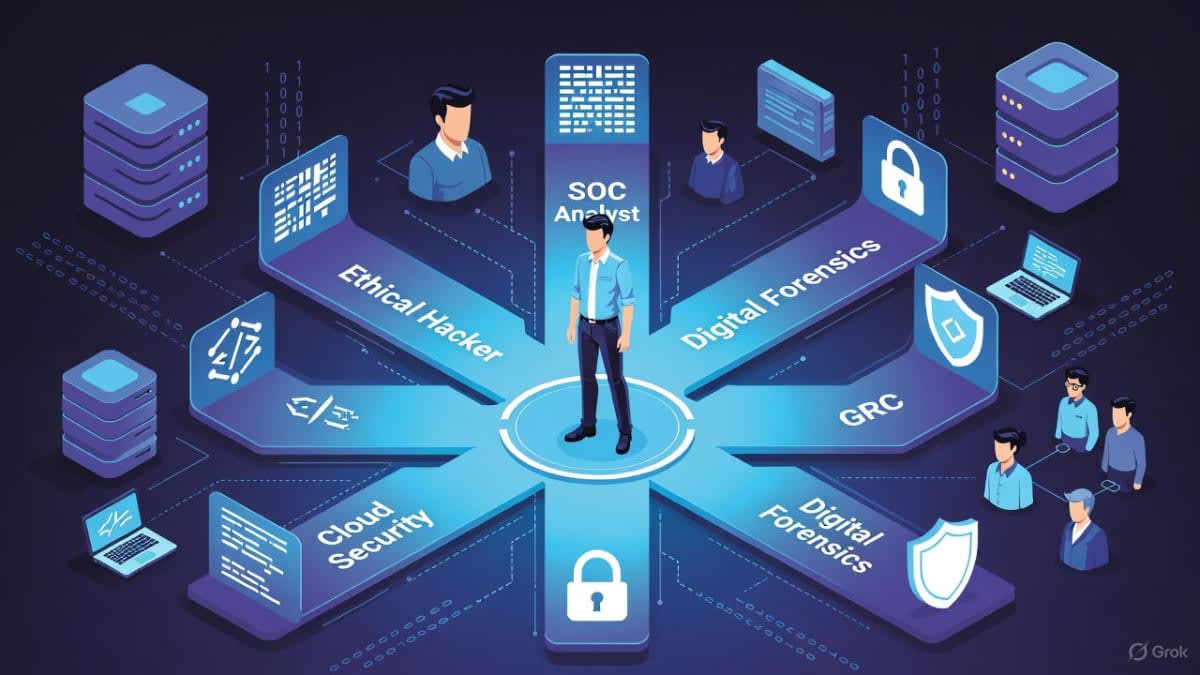
Your Cybersecurity Career Map: Finding the Right Path in a Digital World
Finding the right cybersecurity career path isn't just about picking a job it's about discovering where your skills meet the world's greatest digital challenges. With threats evolving daily, organizations aren't just looking for generic "security people"; they need specialists who can dive deep into specific domains. Whether you're drawn to the strategic puzzle of securing an entire network, the hands-on thrill of responding to live incidents, or the meticulous work of uncovering hidden vulnerabilities, there's a specialized path waiting for you.
This guide breaks down the major cybersecurity specializations not by title, but by the core day-to-day work, required mindset, and real career trajectory for each. We'll move beyond the hype to look at what these jobs actually entail, how they fit together in the security ecosystem, and how you can start building toward the one that's right for you.
Navigating the Cybersecurity Landscape: Where Do You Fit?
Before diving into specific roles, it's helpful to see the big picture. Cybersecurity careers often branch into three primary, interconnected domains:
- Defensive Security (The Protectors): Focused on building and maintaining systems to prevent attacks. This includes roles like Security Engineering and Architecture.
- Offensive Security (The Testers): Focused on proactively finding weaknesses before attackers do. This is the realm of Penetration Testing and Ethical Hacking.
- Incident & Intelligence (The Responders & Analysts): Focused on detecting ongoing threats and mitigating damage. This includes Security Operations Center (SOC) Analysts and Incident Responders.
Think about which of these missions excites you most. Do you want to build the unbreakable castle, test its walls for hidden cracks, or stand guard and sound the alarm when enemies are spotted? Your answer is the first clue to your ideal path.
Specialization 1: The Security Architect & Engineer (The Master Builders)
Core Mission: Design and build secure systems from the ground up. They don't just apply security patches; they create the blueprint that makes patches less necessary.
Specialization 2: The Penetration Tester & Ethical Hacker (The Authorized Adversaries)
Core Mission: Think like an attacker to find and exploit vulnerabilities in systems, networks, and applicationsbut with explicit permission and the goal of making them stronger.
- A Day in the Life: Your work is project-based. You might spend a week performing a black-box test on a new web application, writing a custom script to exploit a found vulnerability, and then meticulously documenting your findings in a report for the client. The work is a blend of technical creativity, rigorous methodology, and clear communication.
- Who Thrives Here: Naturally curious puzzle-solvers who enjoy continuous learning and have a high ethical compass. It requires persistence, deep technical knowledge across various systems, and the ability to explain complex risks to non-technical stakeholders.
- Career Path & Demand: Often begins in roles like SOC Analyst or System Administrator to build foundational knowledge. The path is very certification-driven. Demand is steady and strong from consulting firms, dedicated security companies, and large enterprises. Real-world example: Bug bounty platforms like HackerOne and Bugcrowd showcase how thousands of ethical hackers find and report vulnerabilities to organizations like Google, Microsoft, and GitHub every day.
- Getting Started: Master the basics of networking and operating systems. Dive into platforms like Hack The Box or TryHackMe. The industry-standard entry certification is the Offensive Security Certified Professional (OSCP), known for its challenging hands-on exam.
Specialization 3: The SOC Analyst & Incident Responder (The Digital Firefighters)
Core Mission: Monitor, detect, investigate, and respond to security incidents in real-time. They are the frontline defenders watching over an organization's digital assets 24/7.
- A Day in the Life: In a Security Operations Center (SOC), you're analyzing alerts from security tools, investigating potential phishing emails, reviewing network traffic logs, and escalating confirmed incidents. As an Incident Responder, you're leading the charge to contain a ransomware attack, collecting forensic evidence, and working to eradicate the threat from the network.
- Who Thrives Here: Individuals who work well under pressure, have keen analytical and investigative skills, and can connect disparate pieces of data to form a story. Shift work is common in entry-level SOC roles.
- Career Path & Demand: This is the most common entry point into cybersecurity. Starting as a Tier 1 SOC Analyst, you can advance to Tier 2/3, then specialize in Incident Response, Threat Hunting, or Threat Intelligence. Demand is perpetually high. The 2024 SANS Institute Incident Response Survey found that over 70% of organizations are actively growing their incident response teams.
- Getting Started: Develop strong log analysis skills. Get familiar with tools like Splunk, Elastic Stack, and common Endpoint Detection and Response (EDR) platforms. Foundational certifications like CompTIA Security+ and GIAC Security Essentials (GSEC) are highly valuable. Understand the threats you'll face by reading about DDoS Attacks Explained and Remote Work Cybersecurity Risks.
Specialization 4: The Governance, Risk & Compliance (GRC) Professional (The Strategic Advisors)
Core Mission: Ensure an organization meets regulatory requirements and manages cybersecurity risk from a policy and process perspective. They bridge the gap between technical teams, business leaders, and auditors.
- A Day in the Life: You're updating the organization's security policies, performing risk assessments on new vendors, preparing for an ISO 27001 or SOC 2 audit, and translating complex regulations (like GDPR or CCPA) into actionable controls for the IT team.
- Who Thrives Here: People with strong communication, writing, and organizational skills. You need to understand technology deeply but be more focused on process, policy, and business risk. A background in law, audit, or project management can be a great foundation.
- Career Path & Demand: Paths can start in IT audit, risk management, or even from a technical security role moving into a compliance focus. Demand is soaring due to the increasing number of data privacy laws and regulations worldwide.
- Getting Started: Gain a solid understanding of major frameworks like NIST Cybersecurity Framework, ISO 27001, and key regulations relevant to your region. Certifications like Certified Information Systems Auditor (CISA) and Certified in Risk and Information Systems Control (CRISC) are the gold standards here.
The Unifying Force: Core Skills for Every Path
No matter which specialization you choose, these foundational skills are non-negotiable:
- Relentless Curiosity & Continuous Learning: The threat landscape changes weekly. A passion for learning is your most important tool.
- Fundamental IT Knowledge: You must understand how networks, systems, and applications work before you can secure them.
- Problem-Solving & Analytical Thinking: Cybersecurity is about diagnosing problems and crafting solutions under uncertainty.
- Clear Communication: You must be able to explain technical risks to executives and write clear reports for technical teams.
Your Next Step: Stop Planning, Start Doing
The best way to discover your path is to engage with the material. Don't get stuck in "analysis paralysis."
- Pick One Starting Point: Based on what resonated above, choose one area to explore for the next 90 days.
- Build a Foundation: If you're new, get the CompTIA Security+ certification. It's the broad, respected baseline.
- Get Hands-On Immediately: Create a free-tier cloud account, set up a virtual lab, and start completing challenges on TryHackMe (beginner-friendly) or Hack The Box.
- Connect with the Community: Follow security researchers on Twitter/X, listen to podcasts like "Darknet Diaries," and join local cybersecurity meetups.
The question isn't "Which cybersecurity career is best?" but "Which cybersecurity problem do I want to solve?" Find the work that doesn't feel like work—the puzzles you'd happily lose an afternoon to—and you'll have found your path.
Remember, the field needs diverse thinkers. Whether you're building, breaking, defending, or governing, your unique perspective is an asset. Start where you are, use what you have, and begin building your niche in securing our digital world. For more insights on how technology is reshaping professions, you might find our article on Will AI Replace Cybersecurity Jobs? a relevant read.