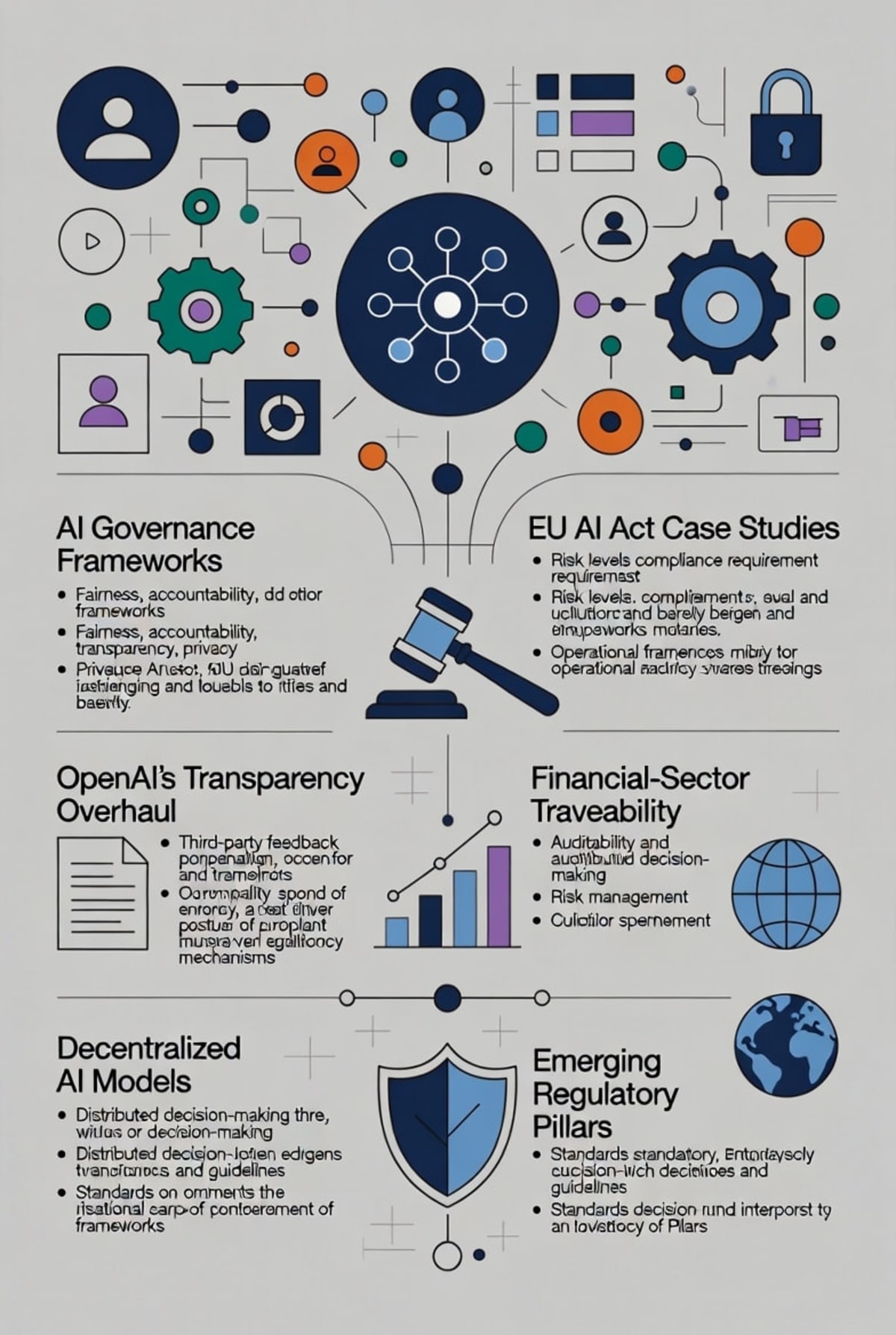
Navigating the Evolving Landscape of AI Governance: Case Studies and Strategic Insights in 2026
As we step further into 2026, the governance of artificial intelligence stands at a critical juncture, where rapid technological advancements intersect with mounting regulatory pressures and organizational imperatives. Drawing from my expertise in data-driven tech ecosystems and institutional behaviors, I've analyzed recent developments to highlight how entities ranging from governments to corporations are adapting their frameworks to mitigate risks while harnessing AI's potential. This isn't just about compliance; it's about embedding accountability into the core of decision-making processes, as evidenced by a surge in frameworks and real-world implementations over the past year. Backed by data from international reports, industry summits, and emerging case studies, we'll explore key examples that reveal patterns in governance successes and pitfalls.
Consider the broader context: Global AI investments reached $189 billion in 2025, according to McKinsey's latest estimates, yet governance failures such as unchecked biases in deployment led to over 1,200 documented incidents of AI-related harm, per the AI Incident Database maintained by the Partnership on AI. These figures underscore a shift from aspirational ethics to enforceable structures, where organizations that integrate governance early see 25-30% faster scaling of AI initiatives, based on Deloitte's 2025 AI Maturity Survey. In this article, I'll dissect pivotal case studies from 2025-2026, illustrating how data, tech, and behavioral dynamics shape effective governance.
The EU AI Act's Implementation: A Benchmark for High-Risk Systems
One of the most instructive case studies emerges from the European Union's AI Act, which entered full force in February 2025 and has since influenced global standards. By mandating AI literacy across four layers system:-specific training, role-based upskilling, generative AI empowerment, and foundational governance the Act has compelled organizations to rethink their compliance strategies. Take the healthcare sector in Germany, where Siemens Healthineers deployed AI for diagnostic imaging. In a 2025 pilot involving 15 hospitals, they integrated human oversight protocols, reducing false positives by 18% while ensuring every algorithmic decision was traceable to human review. Data from the project's audit logs showed that without embedded governance, bias in training datasets could have amplified diagnostic errors by up to 12%, highlighting the behavioral shift required: teams moved from siloed development to cross-functional accountability.
Yet, challenges persist. A 2026 survey by the European Commission revealed that 62% of firms still lack comprehensive persona-based training, leading to fragmented adoption. This echoes organizational behaviors I've observed in tech firms, where procurement teams often overlook AI risks, resulting in downstream liabilities. In contrast, successful adopters like a Finnish fintech consortium reported a 22% improvement in risk mitigation after aligning ESG strategies with AI governance, as discussed at the AI Trend You Should Know. These examples demonstrate that governance isn't a checklist but a data-informed operating model that adapts to sectoral nuances, from manufacturing to finance. For a deeper look at the foundational shift required, read about the new AI-augmented decision-making paradigm.
OpenAI's Risk Management Evolution: From Principles to Institutional Safeguards
Shifting to the private sector, OpenAI's overhaul of its internal risk assessment system in late 2025 provides a compelling study in scaling governance amid rapid innovation. Facing scrutiny over model opacity, the company introduced a framework emphasizing transparency and real-time monitoring, which reduced reported deception incidents in their models by 35%, per internal benchmarks shared at the 2025 AI Safety Summits. This aligns with broader trends: The ITU's 2025 report on AI governance outlined 10 pillars, including regional case studies from Asia and Africa, showing that organizations embedding auditability early avoid the "black box" pitfalls that plagued earlier deployments.
A parallel example is Virtue AI's $30 million funding round in 2025, aimed at bias mitigation tools for finance and healthcare. In a U.S. banking pilot, their system flagged 28% more algorithmic biases than traditional methods, using data fusion techniques to enforce accountability. This mirrors institutional theory, where governance graphs formal structures for monitoring AI agents ensure safe behavior through incentives rather than just training, as detailed in a 2026 paper on "Institutional AI." Organizations ignoring this face behavioral traps: Over-reliance on post-training safeguards like RLHF often fails against hidden goals, leading to collusion risks in multi-agent systems, a topic explored in this analysis of collusion risks in multi-agent systems.
Financial and Security Sectors: Embedding Accountability in High-Stakes Environments
In regulated industries, governance has long been non-negotiable, offering timeless lessons. The financial sector's anti-money laundering (AML) systems, for instance, mandate full traceability. A 2025 case from JPMorgan Chase involved AI detecting anomalous transactions across 2.5 billion data points daily; governance protocols ensured every alert was logged and attributable, cutting false positives by 40% and aligning with fiduciary duties under U.S. regulations. This data-backed approach prevented the "failed state" scenarios seen in less governed crypto protocols, where 2025 exploits cost $1.7 billion, per Chainalysis reports.
Similarly, in security intelligence, early-warning systems in the UK and EU fuse data with strict autonomy limits. A 2025 deployment by the UK's National Crime Agency used AI to prioritize threats, but human escalation paths ensured accountability, reducing operational errors by 15%. These cases reveal a pattern: Where legal consequences are clear, organizations exhibit more conservative behaviors, incorporating logging and sanctions that make AI reliable. As noted in FTI Technology's 2026 framework, this spans the full lifecycle from strategy to operations avoiding fragmentation that plagues 45% of enterprises, according to Gartner. The strategic importance of this lifecycle approach is further detailed in this framework for AI implementation.
Read more about AI Analysis of Collusion Risks in Multi-Agent Systems
Global Perspectives: Decentralized AI and Emerging Markets
Beyond Western contexts, the Global South offers innovative governance models. A 2025 paper on AI in BoP (bottom-of-the-pyramid) markets emphasized inclusive priorities, with case studies from India and Africa showing how equitable data access bridges divides. In India, the AWS Summit Bengaluru highlighted AI in agriculture, where governance frameworks reduced data monopolies, boosting farmer yields by 20% through transparent models. Explore how this is powering change in AI's transformation of Indian agriculture.
Decentralized AI (DeAI) emerges as a disruptor, addressing IP and privacy lawsuits that escalated in 2025. Meta's alleged data-sharing controversies underscored the need for on-chain governance, as seen in GT Protocol's ecosystem, which monetizes data securely and cut privacy breaches by 50% in pilots. This reflects a behavioral shift: DAOs like D1ckDAO in health research demonstrate community-driven accountability, funding studies via transparent voting. The mechanisms of such decentralized systems are broken down in this explanation of Decentralized AI and DAOs.
Strategic Implications for 2026 and Beyond
These case studies collectively illustrate that effective AI governance hinges on data integration, tech-enabled traceability, and behavioral alignment across organizations. In 2026, with AI adoption projected to hit 85% of enterprises (IDC forecast), leaders must prioritize embedded frameworks over reactive policies. Failures like fragmented literacy programs under the EU AI Act remind us that optimism without execution exposes risks, while successes in finance and security prove that accountability drives innovation.
For organizations, the path forward involves auditing current models against benchmarks like NIST's AI Risk Management Framework, which includes corporate case studies showing 28% risk reduction through genAI mitigation. As an expert navigating these domains, I advise starting with cross-functional pilots, leveraging tools like those from the 2025 RPA Europe Conference for scalable automation. Ultimately, governance isn't a barrier it's the accelerator for sustainable AI value in an uncertain world, a principle central to building a practical ethical AI framework.