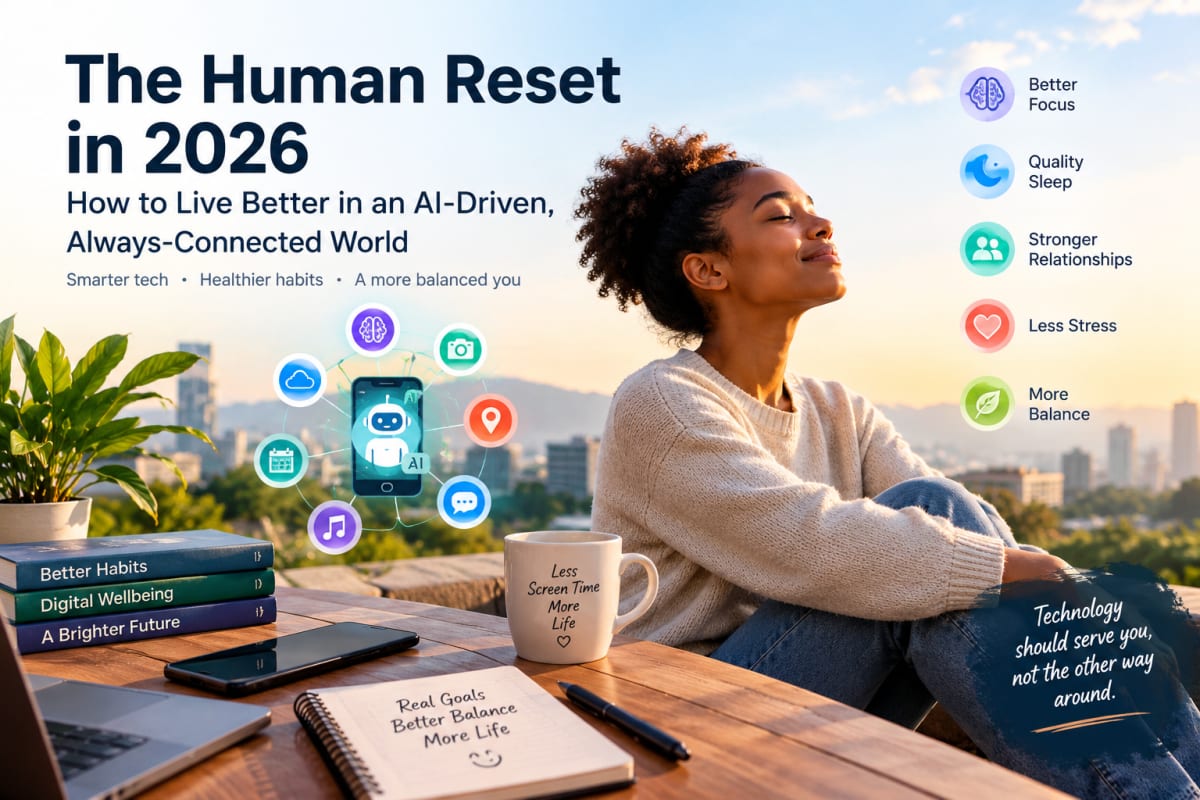
The Human Reset in 2026: How to Live Better in an AI-Driven, Always-Connected World
You wake up and the first thing your hand finds is your phone. Before your feet touch the floor, you have scanned notifications, checked a messaging app, and maybe asked an AI assistant to summarize your day. By evening, you have answered dozens of messages, sat through back-to-back video calls, and scrolled through feeds that somehow knew exactly what would keep you watching. You are connected to everything and everyone, yet you end the day feeling scattered rather than satisfied.
This is not a story about technology being bad. The same tools that fragment your attention also let you work from anywhere, stay close to family across continents, learn skills that once required expensive institutions, and run a business from a smartphone. The problem is not access. It is the absence of boundaries.
The idea of a human reset is not about throwing your phone into a river or rejecting AI. It is about stepping back and asking a more useful question: how can you enjoy the benefits of modern technology without letting constant connectivity dictate your time, attention, and relationships? That question sits at the heart of digital wellbeing in 2026.
What Does Digital Wellbeing Mean in 2026?
Digital wellbeing is the ability to use digital tools in ways that support your goals, responsibilities, relationships, and overall quality of life. It is not a number on a screen-time report. Someone can spend six hours on a device doing meaningful work, learning, or maintaining relationships and be perfectly well. Someone else can spend ninety minutes in passive scrolling and feel worse for it.
The concept has expanded well beyond counting minutes. In 2026, digital wellbeing includes attention and concentration, sleep and evening routines, social media habits, AI-assisted decision-making, digital privacy, information overload, notification management, and the boundaries between work and personal life. The question is not how much time you spend online. It is whether that time is intentional or compulsive, and whether it leaves you feeling more capable or more drained.
How AI Is Changing Everyday Life
AI has quietly moved from novelty to utility. It helps draft emails, plan trips, organize schedules, explain difficult concepts, summarize long documents, and manage smart home routines. Voice assistants and wearable devices are making hands-free computing feel less like science fiction and more like a normal part of the day. For a closer look at how these tools are embedding themselves into daily routines, see our exploration of AI assistants in everyday life.
The benefits are real. Repetitive work shrinks. Information becomes easier to access. But the risks deserve equal attention. Incorrect AI advice, reduced independent problem-solving, privacy concerns, and over-dependence on automated recommendations are not hypothetical. They are the natural byproducts of convenience taken too far. The outcome depends less on the technology itself and more on how deliberately you use it.
The Attention Economy: Why Distractions Are So Persistent
Your attention is valuable, and many products are designed to capture as much of it as possible. Notifications, autoplay, personalized feeds, short-form video, and recommendation systems all compete for the same limited resource. The mechanisms are well understood: variable rewards, infinite scrolling, social comparison, fear of missing out, and frequent context switching.
These systems do not affect everyone in the same way, and using social media deliberately is different from passive scrolling. But it helps to understand the design incentives behind the apps you use. Our analysis of how social media algorithms influence modern lifestyles and decisions goes deeper into the mechanics of personalized feeds and the habits they encourage.
A useful starting point is to ask which apps, notifications, and online habits genuinely serve your goals. The ones that do not are candidates for removal or restriction.
Digital Minimalism Without Giving Up Technology
Digital minimalism is not rejection. It is selection. It means choosing technology based on what you value rather than collecting apps by default or leaving every notification switch turned on.
Practical examples are unglamorous but effective. Remove apps you open out of boredom rather than purpose. Turn off nonessential notifications. Schedule social media sessions instead of checking reflexively. Unsubscribe from emails you never read. Keep your phone out of reach during focused work. Separate work notifications from personal time so that one does not bleed into the other.
None of this requires abandoning AI assistants or deleting your social accounts. A realistic example: someone who works from home might keep messaging apps on for work hours, silence them after 7 p.m., use a focus mode during deep work, and leave their phone in another room during dinner. They remain connected to what matters and disconnected from what does not. For a more detailed approach, read about reducing screen time without losing productivity.
How Constant Connectivity Affects Sleep, Focus, and Daily Energy
Late-night notifications, engaging content, and irregular device habits can interfere with healthy sleep routines. This is not a moral failing. It is a predictable response to stimulation at the wrong time of day.
Practical strategies matter more than willpower. Establish a consistent bedtime. Reduce stimulating screen activity before sleep. Use Do Not Disturb settings so that messages wait until morning. Keep phones away from the bed where practical. Avoid work messages during personal time. Create a relaxing evening routine that does not depend on a screen.
Interruptions affect focus in similar ways. Every notification that pulls you away from a demanding task carries a cost beyond the few seconds it takes to glance at it. Sustained attention becomes harder when the environment is designed to fragment it.
Social Media, Relationships, and Human Connection
Digital communication can strengthen relationships. It keeps distant family close, helps friends coordinate, and creates communities around shared interests. It can also compete with face-to-face interaction in ways that are easy to overlook.
Phone use during meals, the pressure to remain constantly available, and the quiet habit of checking a screen while someone is speaking all send messages about what matters. Online relationships are not inherently inferior to offline ones, but they are different. A messaging thread is not a substitute for a conversation where both people are fully present.
Practical boundaries help. Keep some meals device-free. Give conversations undivided attention. Set realistic response-time expectations so that others know when you are available. Plan in-person activities. Use social media to maintain relationships rather than replace every form of interaction.
Building a Healthier Morning Routine in an AI-Powered World
Mornings set the tone for the rest of the day, but they do not need to start at 5 a.m. or follow someone else's idealized routine. The goal is to begin with intention rather than reaction.
Prepare the night before. Check only essential notifications in the first hour. Use your calendar and reminders deliberately rather than letting a feed decide your priorities. Start with hydration, movement, or another personally meaningful activity before opening social media. If you use AI to organize tasks, let it support your plan rather than dictate it.
A sample morning that can be adapted to different schedules: wake, drink water, spend ten minutes stretching or walking, review your top three priorities for the day, then check messages. That is it. No elaborate protocol required. For more ideas, see our guide to morning routines that actually work in a busy digital world.
Using AI Without Losing Independence
AI can support everyday decisions without replacing personal judgment. It is useful for brainstorming, learning new skills, organizing schedules, summarizing information, comparing options, supporting creative projects, and automating repetitive administrative tasks.
The important habits are simple. Verify important information. Question recommendations that seem too convenient. Maintain the ability to perform essential tasks independently, even if you usually delegate them. Use AI as a supportive tool rather than an unquestioned authority. Be thoughtful about entering personal, financial, professional, or family information into AI services, and understand where that data goes.
When it comes to delegating more complex tasks to autonomous systems, the same principle applies: keep humans responsible for decisions that matter. Our article on AI agents in 2026 explores where delegation makes sense and where oversight remains essential.
Wearable AI, Smart Homes, and the Always-Available Assistant
Smart glasses, watches, earbuds, smart speakers, and connected homes are making technology more integrated into everyday environments. Hands-free assistance, accessibility features, reminders, navigation, and home automation offer genuine convenience.
The trade-offs deserve attention. Constant notifications can follow you everywhere. Audio and visual data collection raises recording concerns. Cloud processing means data leaves your device. Location tracking and dependency on connected services create new forms of vulnerability. Useful technology should respect boundaries and provide meaningful privacy controls. Our analysis of AI smart glasses in 2026 covers these tensions in more detail.
A Practical Seven-Day Human Reset Challenge
This is not a strict program. Adapt it to your circumstances and keep what helps.
Day Action Day 1 Audit app usage and notifications. Notice which apps you open out of habit. Day 2 Turn off unnecessary alerts. Keep only what genuinely needs immediate attention. Day 3 Create one focused, distraction-free work or study session. Day 4 Establish a device boundary during a meal or conversation. Day 5 Create a healthier evening routine. Reduce stimulating screen activity before bed. Day 6 Spend time on an offline activity: walking, reading, exercising, or meeting friends. Day 7 Review what changed and keep the habits that genuinely helped.Reflect on attention, mood, productivity, relationships, and convenience without expecting dramatic results. Small changes sustained over time matter more than intense experiments that end after a week.
Digital Wellbeing for Students, Workers, and Families
Students
Use focus modes during study sessions. Separate learning from entertainment so that one device does not become a constant temptation. Use AI to explain difficult concepts rather than merely copy answers. Schedule breaks. Turn off unnecessary notifications while studying.
Professionals and Remote Workers
Set communication boundaries and communicate them to colleagues. Batch nonurgent messages instead of responding to each one immediately. Protect focused work periods. Separate work and personal devices or accounts where practical. Use automation for repetitive tasks so that your attention goes to work that requires judgment.
Parents and Families
Agree on age-appropriate device boundaries. Model the habits you want to see. Encourage offline activities. Discuss online privacy openly. Keep rules realistic and consistent rather than punitive and sporadic.
Entrepreneurs and Freelancers
Use AI for repetitive work. Limit unnecessary platform switching. Schedule marketing and communication tasks rather than checking constantly. Establish working hours and avoid equating constant availability with productivity.
Digital Wellbeing in Kenya and Other Emerging Digital Markets
In Kenya and many other markets, mobile phones are not optional accessories. They are tools for communication, education, business, and access to financial services. WhatsApp is a primary channel for commerce. Mobile money is embedded in daily life. Reducing digital overload cannot mean losing access to essential services, educational opportunities, customers, or family communication.
Practical suggestions look different in this context. Scheduled downloads and updates can reduce data costs. Notification management helps separate essential communication from optional browsing. Separating work-related WhatsApp groups from personal ones creates a boundary without requiring a second device. Data-conscious usage habits make connectivity more affordable.
The goal is not less technology. It is more intentional technology. The same phone that enables business and family connection does not need to also deliver every possible distraction.
Common Digital Wellbeing Mistakes
- Treating screen time as the only measure of wellbeing. Solution: focus on whether use is intentional and whether it serves your goals.
- Attempting an extreme digital detox that cannot be sustained. Solution: make one small change and keep it.
- Deleting useful tools without a replacement plan. Solution: remove the distraction, not the utility.
- Using AI to automate every personal decision. Solution: keep judgment for choices that matter.
- Ignoring privacy settings. Solution: review permissions and data policies periodically.
- Keeping all notifications enabled. Solution: turn off everything that does not need immediate attention.
- Comparing personal routines with social media influencers. Solution: remember that curated routines are not reality.
- Setting boundaries without communicating them. Solution: tell people when you are available and when you are not.
The Future of Lifestyle in an AI-Driven World
Through 2027 and beyond, AI assistants will become more personalized and context-aware. Daily planning, learning, and household routines will become more automated. Wearable devices will improve. Privacy and digital wellbeing tools will mature in response to consumer demand.
These developments could make daily life more convenient, but they will not automatically improve happiness, relationships, or quality of life. That part remains a human responsibility. The more capable technology becomes, the more important intentional use and personal autonomy become.
Frequently Asked Questions
What is digital wellbeing?
Digital wellbeing is the ability to use digital tools in ways that support your goals, relationships, and quality of life. It is less about total screen time and more about whether your use is intentional and whether it leaves you feeling capable rather than drained.
How can AI affect everyday life?
AI can reduce repetitive work, make information easier to access, and support learning and organization. It can also encourage over-reliance, surface incorrect information, and raise privacy concerns. The outcome depends on how deliberately you use it.
How can I reduce screen time without losing productivity?
Focus on removing distractions rather than useful tools. Turn off nonessential notifications, batch messaging, use focus modes during deep work, and keep your phone out of reach during tasks that require concentration. Productivity comes from attention, not from constant availability.
Does a digital detox mean avoiding all technology?
No. A useful reset is about boundaries, not abstinence. Most people need their devices for work, communication, and daily life. The goal is to use them deliberately rather than reflexively.
How can I use AI without becoming dependent on it?
Verify important information, question recommendations, and maintain the ability to perform essential tasks yourself. Use AI as a tool that supports your judgment, not one that replaces it.
How can I create healthier smartphone habits?
Start with notifications. Turn off everything that does not need immediate attention. Keep your phone out of the bedroom if practical. Schedule social media rather than checking reflexively. Make one change at a time and keep what works.
How can families improve digital wellbeing?
Agree on realistic boundaries, model the habits you want to see, keep some meals device-free, and discuss privacy openly. Consistency matters more than strictness.
What lifestyle changes will matter most in an AI-driven future?
Intentional use, attention management, privacy awareness, and the ability to maintain independent judgment will matter more as AI becomes more integrated into daily life. The technology will change. The need for boundaries will not.
Conclusion: Make Technology Work for Your Life
A healthier digital lifestyle does not require abandoning innovation. It requires using technology deliberately, protecting your attention, maintaining meaningful relationships, preserving privacy, and creating space for rest and personal growth.
Start with one manageable change. Turn off a notification. Keep your phone out of the bedroom. Have one device-free meal. Notice how it feels. Keep what helps. Build from there.
The measure of good technology is not how much of our lives it occupies. It is how well it helps us live the lives we value. That is the human reset worth pursuing in 2026 and beyond.