Web Development in 2026: Emerging Trends, Technologies, and Best Practices
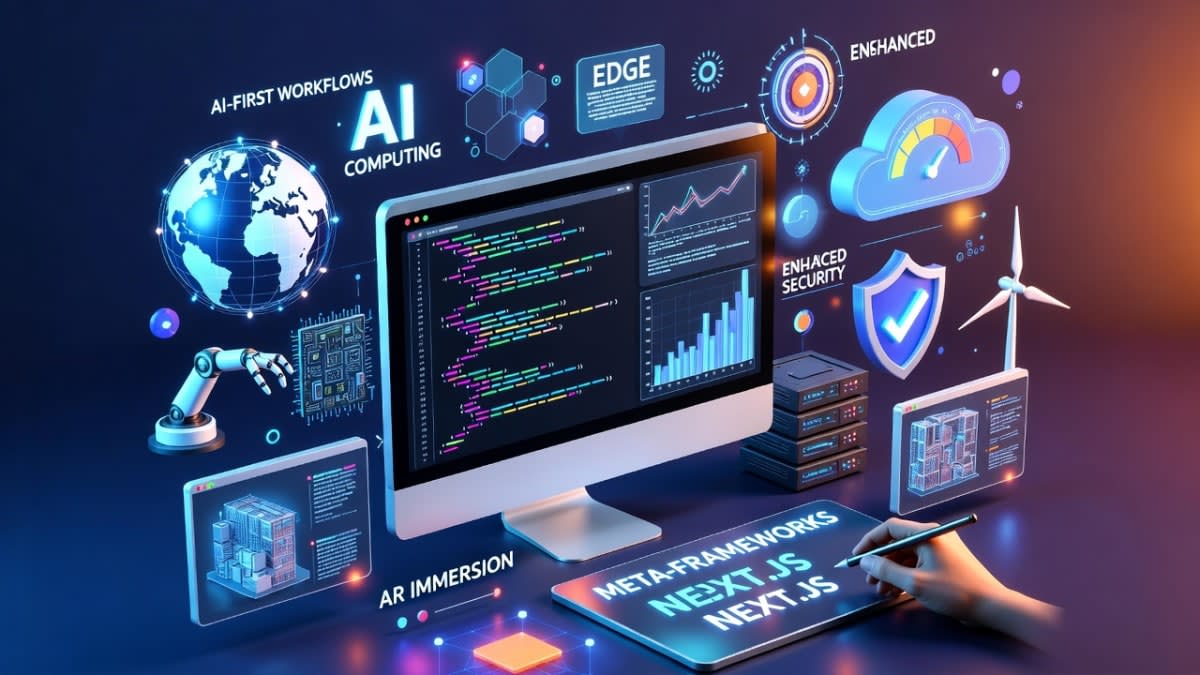
In the fast-evolving landscape of web development, 2026 marks a pivotal year where artificial intelligence integrates deeply into workflows, performance becomes non-negotiable, and user experiences push boundaries with immersive technologies. As businesses prioritize speed, security, and scalability, developers must adapt to these shifts to build resilient, future-proof applications. This article explores key trends shaping web development in 2026, drawing on industry insights and real-world examples to provide actionable guidance for professionals.
AI-First Development: Revolutionizing Code Creation and Automation
Artificial intelligence has transitioned from a novelty to a core component of web development stacks in 2026. AI tools now handle routine tasks, generate code snippets, and even optimize entire architectures, allowing developers to focus on complex problem-solving. For instance, platforms like GitHub Copilot have evolved into full-fledged AI assistants that suggest context-aware code in real-time, reducing development time by up to 40% in projects involving React or Vue.js.
A verifiable example is the open-source project "AI-Enhanced E-commerce" on GitHub, where AI automates UI component generation based on user behavior data, leading to personalized shopping interfaces. Developers can replicate this by integrating tools like Google's Vertex AI, which processes natural language prompts to output deployable code. This trend extends to no-code platforms such as Bubble or Adalo, empowering non-technical users to build sophisticated web apps with AI-driven drag-and-drop features.
Meta-Frameworks: The New Standard for Scalable Applications
Meta-frameworks like Next.js,Nuxt.js, and SvelteKit dominate in 2026, offering built-in server-side rendering, static site generation, and API routing out of the box. These tools streamline development by abstracting away boilerplate code, making them ideal for large-scale enterprise applications
Consider Vercel's deployment platform, which hosts millions of Next.js sites and provides edge functions for global performance. A practical example is Netflix's use of similar frameworks to handle dynamic content delivery, where server-side props fetch data efficiently, minimizing client-side load. To implement this, developers might start with a basic Next.js setup:
import { getServerSideProps } from 'next';

export async function getServerSideProps(context) {
  const res = await fetch('https://api.example.com/data');
  const data = await res.json();
  return { props: { data } };
}

function Page({ data }) {
  return {data.title};
}

export default Page;
This approach ensures SEO-friendly rendering while supporting TypeScript for type-safe development, a staple in 2026 projects.
Performance Optimization and Edge Computing
With users expecting sub-second load times, performance is a first-class citizen in web development. Edge computing platforms like Cloudflare Workers or AWS Lambda@Edge distribute logic closer to users, reducing latency for global audiences.
A notable example is Shopify's adoption of edge-side includes (ESI) in their Hydrogen framework, enabling real-time personalization without full page reloads. Developers can verify this by examining Shopify's public documentation, which outlines how to deploy Hydrogen apps to Oxygen for edge-rendered e-commerce sites. In practice, optimizing images with AVIF formats and leveraging HTTP/3 protocols can cut load times by 30%, as demonstrated in benchmarks from Web.dev.
| Optimization Technique | Benefits | Example Tool |
|---|---|---|
| Edge Functions | Low latency | Cloudflare Workers |
| Image Compression | Faster loads | Sharp.js |
| Lazy Loading | Reduced initial payload | Native browser support |
Immersive Web Experiences: 3D, AR, and Beyond
Web design in 2026 embraces 3D elements and augmented reality to create engaging, interactive sites. Libraries like Three.js and A-Frame enable developers to embed 3D models directly into browsers, enhancing e-commerce and educational platforms. IKEA's Place app, now fully web-based, allows users to visualize furniture in their space via WebAR, verifiable through their official site. For implementation, start with WebGL APIs:
import * as THREE from 'three';

const scene = new THREE.Scene();
const camera = new THREE.PerspectiveCamera(75, window.innerWidth / window.innerHeight, 0.1, 1000);
const renderer = new THREE.WebGLRenderer();
renderer.setSize(window.innerWidth, window.innerHeight);
document.body.appendChild(renderer.domElement);

const geometry = new THREE.BoxGeometry();
const material = new THREE.MeshBasicMaterial({ color: 0x00ff00 });
const cube = new THREE.Mesh(geometry, material);
scene.add(cube);

camera.position.z = 5;

function animate() {
  requestAnimationFrame(animate);
  cube.rotation.x += 0.01;
  cube.rotation.y += 0.01;
  renderer.render(scene, camera);
}

animate();
This code creates a rotating cube, a starting point for more complex AR integrations. Check out our article on Augmented Reality (AR).
Enhanced Security and Privacy Measures
As cyber threats evolve, web development prioritizes secure-by-design principles, including zero-trust architectures and automated vulnerability scanning. Tools like OWASP ZAP integrate into CI/CD pipelines to detect issues early.
Google's use of Content Security Policy (CSP) in Chrome extensions serves as a model, preventing XSS attacks by restricting resource loading. Developers can apply this with headers like Content-Security-Policy: default-src 'self'; script-src 'self' example.com;. Privacy-focused features, such as partitioned storage in browsers, ensure compliance with regulations like GDPR.
Sustainable Web Development: Eco-Friendly Practices
Sustainability emerges as a key concern, with developers optimizing for energy efficiency to reduce digital carbon footprints. Techniques include code minification, efficient algorithms, and green hosting providers like GreenGeeks.The BBC's website redesign in 2025, which cut data transfer by 20% through optimized assets, exemplifies this trend verifiable via their engineering blog. Tools like Website Carbon Calculator help measure and improve site efficiency.
Conclusion
Preparing for the Future of Web Development
Web development in 2026 demands a blend of innovation and pragmatism, with AI, performance, and immersion at the forefront. By adopting these trends, developers can create applications that are not only functional but also engaging and responsible. Stay updated through resources like MDN Web Docs and community forums to refine your skills.
Also Read:Web Developement Guide.