Full-Stack Web Development in 2026: Architecture, AI Integration, Performance & Security Best Practices
There was a time when "full-stack developer" meant someone who could write a Rails controller in the morning and jQuery in the afternoon. That definition has long since expired. Full-stack web development in 2026 spans distributed edge networks, AI-augmented pipelines, cryptographic trust models, and real-time observability all orchestrated by developers who must think as much like architects as they do like engineers.
The transformation did not arrive in a single wave. The shift from monolithic server-rendered pages to API-driven single-page applications was the first major inflection point. The serverless movement followed functions as commodity compute, infinite theoretical scale, pay-per-invocation billing. Now we are inside a third and more consequential wave: the AI-native application. Generative models are no longer just development accelerators. They have become first-class runtime components, embedded in search, content generation, customer support, and the code-writing process itself.
This guide is a practical map of that landscape. It does not chase every new framework or celebrate every trend. Instead it focuses on the architectural decisions, integration patterns, and security postures that determine whether an application holds up under real-world pressure in 2026 and beyond. The target is developers and founders who need to make defensible choices, not just follow consensus.
Modern Frontend Architecture in 2026
The React ecosystem did not collapse under the weight of its own complexity, it matured into something almost unrecognizable from its 2018 form. React Server Components (RSC), now stable and widely deployed in production, have fundamentally changed the hydration contract between server and browser. Developers no longer ship a JavaScript bundle that colonizes the entire DOM. Server components render to a streaming wire format, and only interactive islands get hydrated on the client. This is not partial hydration as a workaround it is hydration as a deliberate, composable architectural primitive.
The Hydration Problem and Its Resolution
For years, the most damaging performance liability of JavaScript-heavy SPAs was Time to Interactive (TTI): the page appeared ready but was frozen while the runtime parsed hundreds of kilobytes or megabytes of JavaScript. Partial rendering patterns, popularized by frameworks like Astro and now native to Next.js 15 and Remix, address this by deferring hydration to component boundaries rather than applying it to the entire page at once. Applications implementing RSC with streaming consistently show 30–50% improvements in Largest Contentful Paint (LCP) and measurable reductions in Total Blocking Time two of the Core Web Vitals signals that directly influence Google search ranking.
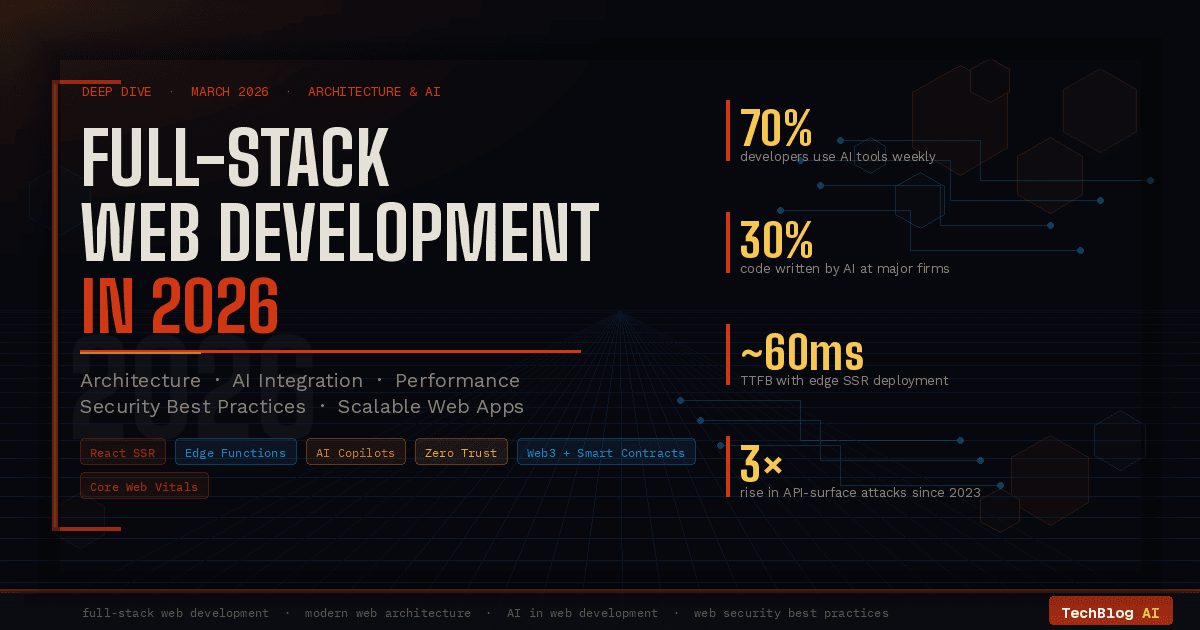
Edge functions complete this architecture. Deploying server-side rendering logic to edge nodes via Cloudflare Workers, Vercel Edge Runtime, or Fastly Compute reduces the physical distance between compute and user. For globally distributed applications, this can collapse Time to First Byte from 400ms to under 60ms for distant users. The architectural constraint is real, however: edge runtimes are deliberately limited. No Node.js APIs, constrained memory, cold-start sensitivity. The edge layer should be designed as a thin personalization, routing, and rendering layer not a full application server.
Core Web Vitals as an Architectural Constraint
Teams that treat Core Web Vitals as a post-launch optimization consistently underperform those that incorporate them as upfront architectural constraints. LCP, INP (Interaction to Next Paint, which replaced FID in 2024), and CLS are not abstract user satisfaction metrics; they are measurable indicators of rendering efficiency, JavaScript scheduling discipline, and layout stability. Each has a corresponding architectural remedy. LCP requires preloading critical resources and eliminating render-blocking dependency chains. INP demands long-task budgeting and deliberate main-thread yielding via `scheduler.yield()` or task chunking. CLS requires explicit dimension reservation on dynamic content:- images, embeds, skeleton screens before it loads.
The performance budget should be established before implementation begins, reviewed at the component level, and enforced through CI tooling like Lighthouse CI or Web Vitals integrations in your deployment pipeline.
Backend Architecture & Scalability
The monolith-versus-microservices debate has settled into something more nuanced than either camp originally argued: modular monoliths for early-stage products, microservices for teams that have identified and proven their domain boundaries, and serverless functions for workloads with spiky or fundamentally unpredictable traffic shapes. The right architecture is not a fixed answer it is a function of team size, traffic profile, and operational maturity.
The Real Cost of Microservices
Microservices remain the architecture of choice at scale, but the operational tax is substantial and frequently underestimated. Distributed tracing, service mesh configuration via Istio or Linkerd, inter-service authentication, independent deployment pipelines, and the complexity of eventual consistency across service boundaries each of these requires platform engineering investment that most teams cannot absorb early. Organizations that succeed with microservices in 2026 are those that have invested in internal developer platforms: golden paths that abstract the complexity of Kubernetes, service discovery, and observability behind opinionated, team-specific tooling. Without this platform layer, microservices typically produce slower delivery velocity, not faster.
Serverless and the API-First Mandate
Serverless has found its natural habitat: event-driven workloads, background processing, webhook handlers, and AI inference pipelines. AWS Lambda, Cloudflare Workers, and Google Cloud Run manage the scaling dimension automatically, making them the correct choice for the long tail of application functionality that does not justify dedicated infrastructure. Improvements to the ecosystem better cold-start performance, persistent WebSocket connections at the edge, and more capable observability tooling have removed most of the remaining production objections.
API-first design is no longer optional in an environment where a single application may be consumed simultaneously by a mobile client, a third-party integration, an AI agent, and a web frontend. OpenAPI 3.1 specifications combined with contract testing via tools like Pact create a durable shared contract between producers and consumers that survives team turnover and enables parallel development without coordination overhead. GraphQL remains the right tool for complex, frontend-driven data requirements where multiple consumers need different shapes from the same underlying data. REST with proper HTTP semantics continues to win on simplicity, caching infrastructure compatibility, and developer experience for the majority of production APIs.
Backend Integration with AI Systems
The architectural novelty of 2026 is not the AI model itself it is the challenge of integrating AI as a runtime dependency with its own latency, failure, and cost profile. Applications now call language model APIs as part of their synchronous request path, which introduces response times measured in seconds rather than milliseconds, probabilistic failures that differ fundamentally from deterministic API errors, and per-token cost structures that can spike unexpectedly under load. Streaming responses via Server-Sent Events or WebSockets are table stakes for any user-facing AI endpoint. Circuit breakers, cost-aware rate limiting, fallback content strategies, and graceful degradation when model APIs are unavailable are backend engineering requirements that did not exist before the LLM era but are now production-critical concerns.
AI Integration in Web Applications
AI integration in web applications has moved decisively past the proof-of-concept phase. The question is no longer whether to integrate AI, but how to do it reliably and where the real capability limits lie.
Comprehensive research on AI code generation in 2026 makes clear that tools like GitHub Copilot, Amazon CodeWhisperer, and Claude Code are now used by over 70% of professional developers not for autonomous application development, but for targeted acceleration of well-understood tasks: boilerplate generation, test scaffolding, regular expression construction, documentation, and repetitive CRUD logic. The productivity gains are real but unevenly distributed. Experienced developers extract significantly more value because they can evaluate AI output critically and recognize when it fits their specific context. Junior developers, by contrast, sometimes accept plausible-looking code that contains subtle security vulnerabilities or architectural mismatches with the rest of the codebase.
What AI Copilots Actually Do Well
AI copilots excel at pattern completion within established boundaries. Generating a TypeScript interface from a JSON schema, converting a REST endpoint to GraphQL, writing unit tests for a pure function, scaffolding a database migration these tasks play to the model's core strength: recognizing patterns and completing them with syntactically and semantically coherent output. The developer remains the architect; the AI executes within the decision space the developer defines.
The failure modes are equally important to understand honestly. As analysis of [what happens to software engineering when AI writes most of the code](https://aitechblogs.netlify.app/post/when-ai-writes-almost-all-code-what-happens-to-software-engineering) demonstrates, complex business logic, security-critical implementation, and high-level architectural decisions still require human judgment that models cannot reliably replicate. Junior developer employment fell nearly 20% between 2022 and 2025, but this reflects a skills shift rather than industry contraction. Developers who can orchestrate AI systems, evaluate their output critically, and maintain architectural coherence across a codebase are more valuable than they have ever been. The role is evolving from implementation to specification and verification.
Human-AI Collaboration as a Design Pattern
The most effective development teams treat AI assistance as a force multiplier for human expertise, not a substitute for it. This means defining explicit review gates never shipping AI-generated security-sensitive code without human audit and building feedback loops that improve prompt quality over time. Passive acceptance is the primary failure mode to defend against: developers who review AI output the way they skim a Stack Overflow answer, looking for the green checkmark rather than evaluating whether the implementation fits their specific constraints, edge cases, and security requirements.
Practical guideline:Treat AI-generated code with the same review discipline you would apply to a pull request from a capable contractor who lacks full context on your system. The code may be syntactically correct and follow common patterns while missing critical domain constraints that exist only in your codebase's institutional knowledge.
Blockchain & Decentralized Web
Blockchain technology has matured past its speculative peak into something more useful and more limited: a targeted solution for specific classes of problems where decentralized trust, immutability, and programmable contracts provide genuine value over centralized alternatives. Most web applications do not need blockchain. Some do. Knowing the difference is what separates architectural judgment from hype.
For developers who want to build a rigorous technical foundation before making architectural decisions, [this developer guide to blockchain and the decentralized web]covers the cryptographic primitives and consensus mechanisms in the depth required for production decision-making.
When Blockchain Provides Genuine Architectural Value
The use cases where blockchain provides a real advantage share a common structure: multiple parties who do not fully trust each other need to coordinate around a shared state, and a central intermediary is either unavailable, prohibitively expensive, or an unacceptable single point of failure. Supply chain provenance tracking across organizational boundaries, cross-institutional credential verification, decentralized identity systems, and tokenized asset management fit this profile well. A standard CRUD web application with a single operator and a trusted user base does not.
Smart Contracts as Application Logic
Smart contracts deployed on EVM-compatible chains :- Ethereum, Polygon, Arbitrum or on Solana allow developers to encode business rules that execute deterministically without a central operator. The integration pattern for web applications typically involves a lightweight frontend that signs transactions via a wallet connection library (Wagmi, RainbowKit), and a backend indexer The Graph or a custom event listener that maintains a queryable read model of on-chain state. This architecture deliberately separates the write path (on-chain, slow, expensive, immutable) from the read path (off-chain, fast, indexed, queryable), which is the foundational design decision that makes usable Web3 applications possible.
One constraint is non-negotiable: smart contracts holding user funds or enforcing access control must be audited by firms specializing in Solidity or Rust contract security before deployment. Unlike a buggy API endpoint that can be patched in the next deploy, a flawed smart contract can result in irreversible loss at scale.
---Prompt Engineering & Developer Productivity
Prompt engineering has crossed from the domain of AI researchers into the daily practice of software developers. The ability to communicate intent precisely to a language model for code generation, test writing, documentation, data transformation, or debugging assistance is now a productivity skill on the same tier as knowing your way around a debugger or a profiler.
The definitive guide to mastering AI outputs in 2026 provides a comprehensive framework for structured prompting. The core insight for developers is that prompt engineering is not about discovering magic phrases it is about providing sufficient context, constraints, and output format specifications so that the model generates something that fits your specific situation rather than a generalized approximation of what you asked for.
Prompt Patterns for Coding Workflows
Effective developer prompts share a structure: role specification, task definition, constraint enumeration, and output format. Instead of writing "write a login function," a well-engineered prompt specifies the framework (Next.js 15 App Router), the authentication strategy (JWT with refresh token rotation), the error handling contract (typed Result types, no thrown exceptions crossing module boundaries), the database client in use (Drizzle ORM with a PostgreSQL schema already in context), and the testing requirement (Jest unit tests included, testing the happy path and three failure cases). The delta between these two prompts determines whether the AI output needs one pass of revision or five.
System prompts stored in version control shared across a team's AI tooling configuration are an emerging practice that standardizes how an organization interacts with AI models. These prompts act as institutional memory: encoding code style preferences, security constraints, API conventions, naming patterns, and architectural rules that every developer's AI interactions should respect. Teams that invest in this prompt infrastructure layer see more consistent and contextually appropriate AI output across their codebase, and they reduce the onboarding time for new developers who need to use the AI tools effectively from day one.
Emerging Web Trends in 2026
The emerging trends shaping web development in 2026 point toward a convergence of forces that are individually significant but together are reshaping the discipline's fundamentals in ways that will persist for a decade.
WebAssembly Escaping the Browser
WASM has moved decisively beyond its browser origins. WASM modules running in Cloudflare Workers, Fastly Compute, or dedicated runtimes like Wasmer offer near-native execution performance with a portable binary format that sidesteps the Node.js cold-start problem entirely. For compute-intensive server-side workloads such as image and video processing, cryptographic operations, physics simulation, AI inference at the edge WASM is displacing JavaScript as the runtime of choice. The Rust-to-WASM toolchain has matured enough for production deployment, and the component model specification is making cross-language interoperability tractable for the first time.
AI-Native Application Patterns
Retrieval-Augmented Generation (RAG) architectures have become a standard pattern for applications that need to ground AI responses in proprietary or recent data. The architecture is now well-understood: embed documents into a vector store (Pinecone, pgvector, Weaviate, Qdrant), retrieve semantically relevant chunks at query time, and inject them into the model's context window alongside the user's query. The engineering frontier has shifted from getting RAG to work to making it work reliably, handling retrieval failures gracefully, managing context window budget constraints, chunking documents intelligently to preserve semantic coherence, and evaluating output quality systematically with automated evals rather than relying on anecdotal developer testing.
Local-First Software and Data Sovereignty
Local-first software applications that store primary data on the client and synchronize to the server asynchronously is experiencing a genuine revival driven by AI privacy concerns and significant improvements in browser storage capabilities. CRDTs (Conflict-free Replicated Data Types), implemented in libraries like Automerge and Yjs, make conflict resolution tractable for collaborative applications without requiring a central coordination server. The architecture delivers offline functionality as a first-class capability, reduces server infrastructure load at scale, and gives users meaningful data sovereignty; a differentiated position in a market that is increasingly skeptical of the cloud-first data practices of the previous decade.
Security & Performance Best Practices
Security in 2026 is not a compliance checklist; it is a continuous architectural discipline. The threat surface has expanded in proportion to the application surface: AI-specific vulnerabilities, supply chain attacks on npm packages, and API abuse at scale are now standard concerns alongside the perennial OWASP Top Ten.
Zero Trust Architecture
Zero trust is a principle before it is a product: never trust, always verify, minimize access scope at every boundary. In practice, this means every service-to-service request is authenticated and authorized, regardless of whether it originates inside a private network perimeter. Mutual TLS between microservices, short-lived JWT tokens with narrow claims, and per-request policy evaluation via Open Policy Agent implement zero trust at the infrastructure level. The perimeter security model ( trust everything inside the firewall) is architecturally incompatible with the distributed, multi-cloud deployments that define 2026 infrastructure. A compromised internal service should not have standing access to every other service in the system.
Content Security Policy and Supply Chain Defense
A strict Content Security Policy remains one of the highest-ROI security measures available to frontend teams. A well-configured CSP prevents XSS payload execution even when an injection vulnerability exists in the application; it is defense in depth with a low implementation cost relative to its impact. The current best practice is a nonce-based CSP that allowlists only scripts explicitly authorized per request, eliminating the `'unsafe-inline'` escape hatch that undermines most deployed CSP configurations. Pair this with Subresource Integrity checks on all third-party script and stylesheet loads to defend against CDN-level supply chain compromises a threat vector that became significantly more common between 2023 and 2025.
Rate Limiting and API Authentication
API abuse has scaled with AI-powered automation tooling. Credential stuffing, automated scraping, and enumeration attacks now operate at volumes and speeds that make IP-based rate limiting insufficient as a sole defense. Effective API protection in 2026 layers multiple signals: token bucket rate limiting scoped per authenticated identity, anomaly detection on request behavior patterns, bot fingerprinting at the edge layer, and adaptive challenge mechanisms for sessions exhibiting suspicious characteristics. OAuth 2.1 with PKCE is the current standard for user-delegated authorization flows. API keys with short rotation cycles and per-key scope restrictions handle service-to-service authentication. Neither pattern is optional for any API exposed to the public internet.
AI-Specific Vulnerabilities
Applications that expose language model interfaces to users introduce a vulnerability class that has no direct precedent in traditional web security: prompt injection. Malicious users craft inputs designed to hijack the model's behavior, potentially exfiltrating data from the context window, bypassing access controls embedded in the system prompt, or generating content that violates application policy and legal requirements. Effective defense requires treating all LLM output as untrusted user input: validate and sanitize before rendering, never expose raw model output as executable content, implement output filtering layers for policy-violating responses, and log model interactions at a level of detail that enables post-incident investigation. The OWASP LLM Top 10 is the current reference framework for this vulnerability class and should inform threat modeling for any AI-integrated application.
Caching Strategy and CDN Architecture
The performance ceiling for any web application is largely determined by its caching architecture. The layered model:- browser cache, CDN edge cache, application-level cache (Redis or Memcached), database query cache should be designed before implementation, not retrofitted after a production performance incident. Cache-Control header semantics need explicit design decisions: `stale-while-revalidate` for pages that tolerate brief staleness, `no-store` for authenticated or personalized content, and `immutable` with long max-age for content-hashed static assets. CDN cache invalidation strategy is frequently overlooked and needs the same deliberate design as the caching strategy itself. Surrogate keys or cache tags supported by Fastly, Cloudflare, and Varnish enable surgical cache invalidation without wholesale purges that temporarily collapse cache hit rates.
Architecture Thinking as the Core Developer Skill
The developers who will define the next decade of web applications are not distinguished primarily by the frameworks they know frameworks change too fast for framework fluency to be a durable competitive advantage. They are distinguished by their capacity to reason about systems: how components interact under sustained load, where trust boundaries must be enforced, which abstractions will age gracefully and which will calcify into constraints, and how to integrate AI capabilities without ceding architectural control over system behavior.
Full-stack web development in 2026 rewards breadth and depth simultaneously. Breadth, because the modern stack spans edge compute, distributed backend services, AI inference pipelines, cryptographic systems, and browser rendering engines and decisions made in any one layer have consequences in the others. Depth, because the performance and security requirements at each layer demand genuine expertise rather than surface-level familiarity with default configurations.
The practical implication is this: invest in understanding primitives. Edge functions are HTTP request handlers with a constrained runtime. Vector databases are approximate nearest-neighbor search engines with embedding model integrations. Smart contracts are deterministic functions deployed to a distributed state machine. Strip away the marketing layer from any emerging technology and you find familiar computer science concepts applied in new contexts. That pattern recognition (that architectural intuition) is what enables a skilled developer to evaluate new technology honestly, adopt it where it fits, and reject it where it does not.
AI augmentation of development workflows is real, accelerating, and unevenly distributed in its benefits. The developers who extract the most value from it are those who use AI to execute within a clearly reasoned architectural framework, not those who outsource architectural thinking to a model that has no stake in the outcome and no context on the constraints. The long-term shift is from writing code to designing systems and that shift rewards precisely the kind of deliberate, first-principles reasoning that has always separated engineers who build things that last from those who build things that work until they don't.
Frequently Asked Questions
Is React still the right choice for new projects in 2026, or should teams consider alternatives?
React with Server Components is a strong default for most new projects, particularly where teams already have React expertise. The ecosystem depth Next.js, Remix, the broader tooling and library surface provides practical advantages that outweigh the raw performance edge of lighter alternatives like Svelte or Solid for most production use cases. For content-heavy sites with minimal interactivity, Astro's island architecture often delivers better performance with lower complexity. The decision should be driven by traffic shape, team capability, and integration requirements not by framework popularity rankings.
When does a startup genuinely need microservices, and when is a monolith the better choice?
Start with a modular monolith unless a specific domain boundary is already proven and has genuinely divergent scaling requirements. Microservices add distributed systems complexity network latency, partial failure modes, distributed tracing, independent deployment coordination that compounds operational burden before product-market fit is established. Extract a service when a specific domain has independent scaling needs, clear team ownership boundaries, or deployment cadences that differ significantly from the rest of the system. Many companies generating substantial revenue operate modular monoliths without meaningful architectural disadvantage.
How should teams handle security review of AI-generated code?
Treat AI-generated code as external contributions requiring the same scrutiny as any third-party pull request. Establish explicit review gates for security-sensitive paths: authentication logic, authorization enforcement, cryptographic operations, and any code that processes or stores user data. Static analysis tools Semgrep, Snyk, CodeQL should run on all code regardless of origin. For high-risk areas, require review by a developer with specific security expertise rather than standard peer review. Maintain audit trail documentation of which components were AI-assisted as part of your security posture.
What does zero trust mean practically for a web application team without dedicated security engineering?
At a minimum: authenticate and authorize every service-to-service request, including internal services on private networks. Use short-lived tokens with narrow scope rather than long-lived credentials. Give each service database credentials scoped to only the tables and operations it legitimately requires. Rotate secrets on a defined schedule and immediately on suspected compromise. These four practices implement the core zero trust principle never assume legitimacy based on network position without requiring a dedicated security team or expensive enterprise tooling.
Is prompt engineering a durable skill, or will it become obsolete as models improve?
Prompt engineering is a durable competency, though its form will evolve as models improve. The core skill being developed expressing intent precisely, decomposing ambiguous requirements into structured constraint-bounded specifications, and anticipating where an AI system will make incorrect assumptions transfers directly to writing better technical specifications, clearer architecture decision records, and more precise API contracts. Even as models become more capable at inferring intent from vague instructions, the ability to specify requirements with precision will remain valuable in any collaborative context, human or AI.