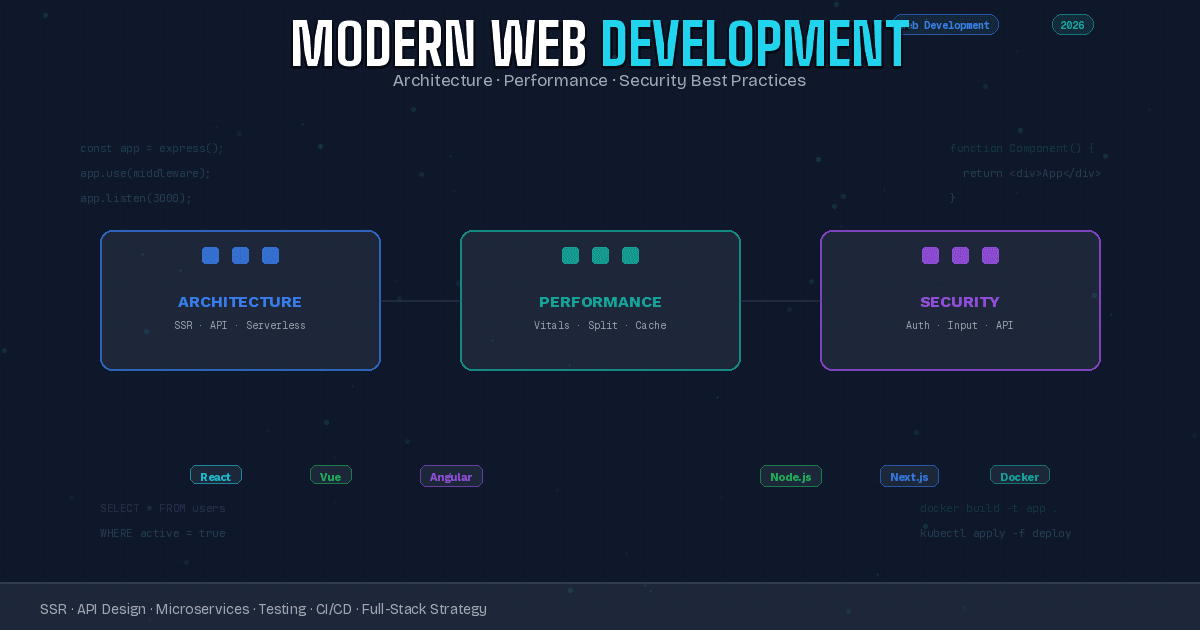
Modern Web Development in 2026: Architecture, Performance, and Security Best Practices
Quick Answer: Modern web development in 2026 balances three competing priorities: building fast, feature-rich applications while maintaining security and managing increasing complexity. Successful teams adopt architectures that scale, prioritize performance as a feature rather than an afterthought, and implement security measures throughout the development lifecycle rather than bolting them on at the end.
Web development has reached a complexity level that would have seemed unrealistic a decade ago. Applications that once ran entirely on servers now split logic between client and server. Static sites that once served simple HTML now generate dynamic experiences through sophisticated build pipelines. Security threats that once targeted servers now exploit browsers, APIs, supply chains, and infrastructure configurations with equal frequency.
This guide addresses the practical realities of building web applications in 2026. It is written for developers making architectural decisions, technical leads planning implementations, and engineering managers allocating resources. You will find specific guidance on architecture patterns that work, performance optimization that delivers measurable results, and security practices that actually protect users without making development impossible.
The web platform continues to evolve rapidly. New frameworks appear regularly. Browser capabilities expand. Security threats adapt. The challenge is not keeping up with every new tool or trend. The challenge is building a coherent strategy that delivers reliable, secure, performant applications while managing the inherent complexity of modern web development.
Why Web Development Faces Unique Challenges in 2026
The fundamental challenge facing web development teams is managing complexity that has grown faster than tooling and practices have evolved to handle it. A typical modern web application involves frontend frameworks, backend APIs, databases, authentication systems, content delivery networks, monitoring tools, and deployment pipelines. Each component introduces potential failure points, security vulnerabilities, and performance bottlenecks.
Industry observers note that the average web application now depends on hundreds of third-party packages. Each dependency represents code written by someone else, with its own maintenance schedule, security posture, and breaking changes. Managing this dependency tree requires constant vigilance and creates supply chain security risks that were barely discussed five years ago.
Performance expectations have increased while applications have become more complex. Users expect sub-second page loads and instant interactions regardless of device or network conditions. Meeting these expectations while delivering rich functionality requires careful architecture decisions and ongoing optimization work. Many development teams underestimate how much effort performance optimization requires when treated as an afterthought rather than a fundamental design constraint.
Security requirements have expanded beyond traditional concerns like input validation and SQL injection. Modern web applications must defend against cross-site scripting, cross-site request forgery, authentication bypass, authorization flaws, API abuse, dependency vulnerabilities, infrastructure misconfiguration, and targeted attacks on specific users or organizations. The attack surface has grown substantially while the consequences of security failures have become more severe.
Key Architecture Patterns and When to Use Them
Server-Side Rendering with Hydration
Server-side rendering generates HTML on the server and sends complete markup to the browser. The client-side JavaScript then "hydrates" this HTML, attaching event handlers and making the page interactive. This pattern delivers fast initial page loads and good SEO while maintaining the benefits of client-side interactivity.
This approach works well for content-heavy applications where initial load performance matters significantly. E-commerce sites, marketing pages, blogs, and documentation sites benefit from fast time-to-first-byte and immediate content visibility. The tradeoff is server load increases compared to pure client-side rendering, and the implementation complexity is higher than simpler approaches.
Static Site Generation with Incremental Regeneration
Static site generation builds all pages at build time, creating static HTML files that can be served directly from a CDN. Incremental regeneration allows updating individual pages without rebuilding the entire site. This pattern delivers the best possible performance for content that changes infrequently.
Marketing sites, documentation, blogs, and product catalogs that update on predictable schedules work well with this pattern. The limitation is that dynamic, personalized content requires client-side fetching or edge functions to supplement the static base. For applications with frequently changing data or heavy personalization requirements, this pattern becomes less practical.
API-First Architecture with Backend for Frontend
API-first architecture separates the backend into distinct services that expose APIs consumed by frontend applications. The Backend for Frontend pattern adds an intermediate API layer tailored to specific frontend needs, aggregating and transforming data from multiple backend services.
This architecture supports multiple client applications — web, mobile, desktop — consuming the same core services while each frontend gets an optimized API surface. It works well for organizations with multiple client platforms and teams that can operate independently. The complexity cost is substantial: you maintain multiple API layers, coordinate changes across services, and manage inter-service communication.
Serverless with Edge Computing
Serverless architecture runs code in response to events without managing servers. Edge computing pushes computation to network locations closer to users. Combining these patterns allows request handling at the edge with minimal latency while backend logic runs on-demand without infrastructure management.
This approach scales automatically and can reduce operational costs for variable workloads. It works well for applications with unpredictable traffic patterns or global user bases. The tradeoff is cold start latency, vendor lock-in concerns, and debugging complexity. Functions must be designed for stateless operation, which constrains certain implementation patterns.
Progressive Enhancement with Core Functionality
Progressive enhancement starts with working HTML and CSS that delivers core functionality, then adds JavaScript to enhance the experience. This pattern ensures applications work across all devices and browsers while providing richer experiences where capabilities allow.
This approach is particularly valuable for applications serving diverse user bases with varying devices and network conditions. It requires more planning than JavaScript-first approaches but delivers resilience and accessibility benefits that matter for many real-world use cases.
Performance Optimization Techniques That Actually Matter
Core Web Vitals Optimization
Core Web Vitals measure user-centric performance: Largest Contentful Paint measures loading speed, First Input Delay measures interactivity, and Cumulative Layout Shift measures visual stability. These metrics correlate with user satisfaction and influence search rankings.
Optimizing LCP requires prioritizing critical resources, optimizing images, minimizing render-blocking resources, and reducing server response time. Improving FID means minimizing JavaScript execution time, breaking up long tasks, and optimizing event handlers. Reducing CLS requires setting explicit dimensions for media elements, avoiding inserting content above existing content, and using transform animations instead of animations that trigger layout shifts.
Code Splitting and Lazy Loading
Code splitting divides JavaScript bundles into smaller chunks loaded on-demand. Lazy loading defers loading non-critical resources until needed. Both techniques reduce initial page weight and improve load performance.
Implement route-based code splitting where each page loads only the code it needs. Use dynamic imports for components that appear conditionally or below the fold. Lazy load images using native loading="lazy" attributes or intersection observer APIs. The benefit is immediate: smaller initial bundles mean faster load times, particularly on slower networks.
Resource Hints and Preloading
Resource hints tell browsers about resources they will need before explicit references appear. DNS prefetch resolves domain names early. Pre-connect establishes connections to important origins. Prefetch downloads resources that will likely be needed soon. Preload prioritizes critical resources.
Use preload for critical resources needed during initial render. Use prefetch for resources needed on likely next navigation. Use pre-connect for third-party domains you will fetch from. These techniques improve performance by allowing browsers to work ahead while parsing and rendering.
Caching Strategy Implementation
Effective caching reduces server load and improves response times. HTTP caching headers control browser caching. Service workers enable sophisticated client-side caching strategies. CDN edge caching serves static assets from locations closer to users.
Implement long-term caching for static assets with content hashing in filenames. Use stale-while-revalidate for API responses that can tolerate slightly stale data. Cache static assets aggressively at the CDN level. Use service workers for offline functionality and instant repeat visits. The complexity is in cache invalidation: ensure you can update cached content when necessary.
Database Query Optimization
Database queries often become performance bottlenecks as applications scale. Optimize queries by adding appropriate indexes, avoiding N+1 queries through eager loading, implementing database-level pagination, and caching expensive query results.
Profile slow queries in production to identify optimization opportunities. Add indexes for frequently queried columns and foreign keys. Use database explain plans to understand query execution. Implement query result caching for data that changes infrequently. For very high-scale applications, consider read replicas to distribute query load.
Security Best Practices Throughout Development
Authentication and Authorization
Authentication verifies user identity. Authorization determines what authenticated users can access. Both must be implemented correctly to protect applications and data.
Use established authentication protocols like OAuth 2.0 and OpenID Connect rather than building custom systems. Implement multi-factor authentication for sensitive operations. Never store passwords in plain text; use bcrypt or Argon2 with appropriate work factors. Implement proper session management with secure, httpOnly, sameSite cookies. Validate authorization on every request; never trust client-side authorization checks alone.
Input Validation and Sanitization
All user input is untrusted and must be validated and sanitized. Input validation prevents many common vulnerabilities including SQL injection, cross-site scripting, and command injection.
Validate input on both client and server. Client-side validation provides immediate feedback but can be bypassed; server-side validation provides security. Use parameterized queries or ORM methods that automatically escape values to prevent SQL injection. Sanitize user-provided HTML using established libraries rather than writing custom sanitization logic. Implement strict content security policies to limit damage from any XSS vulnerabilities that slip through.
Dependency Management and Supply Chain Security
Third-party dependencies introduce code you do not control into your application. Each dependency is a potential security vulnerability or supply chain attack vector.
Audit dependencies regularly using tools like npm audit or Snyk. Keep dependencies updated to receive security patches promptly. Minimize dependencies by evaluating whether you truly need each package. Use lock files to ensure consistent dependency versions across environments. Consider using tools that check for known malicious packages or suspicious maintainer changes. Implement content integrity checks for CDN-hosted resources.
API Security
APIs expose application logic and data to external requests. Securing APIs requires authentication, authorization, rate limiting, input validation, and protection against common API vulnerabilities.
Require authentication for all non-public endpoints. Implement role-based access control to limit what authenticated users can access. Use rate limiting to prevent abuse and denial of service attacks. Validate and sanitize all API inputs. Return appropriate error messages that do not leak implementation details. Use HTTPS exclusively for API communication. Implement CORS policies that restrict which origins can access your APIs.
Infrastructure Security
Infrastructure configuration mistakes create security vulnerabilities even when application code is secure. Cloud misconfigurations regularly expose sensitive data.
Follow the principle of least privilege: grant only the minimum necessary permissions to services and users. Encrypt data at rest and in transit. Use environment variables for secrets; never commit secrets to version control. Implement proper network segmentation. Keep infrastructure components updated with security patches. Use infrastructure as code to ensure consistent, auditable configurations. Regularly audit cloud configurations for security issues.
Frontend Framework Selection Considerations
Choosing a frontend framework is one of the most consequential decisions in modern web development. The choice affects developer productivity, application performance, hiring, and long-term maintainability.
React remains the most widely adopted framework with the largest ecosystem and talent pool. It provides flexibility and works well for complex applications but requires additional libraries for routing, state management, and server rendering. Next.js builds on React to provide these capabilities in an integrated framework.
Vue offers a gentler learning curve than React while providing comparable capabilities. It works well for teams that want a more batteries-included experience than React provides but with less complexity than Angular. Nuxt adds server rendering and static generation capabilities to Vue.
Angular provides a complete framework with strong opinions about architecture and tooling. It works well for large enterprise applications with many developers where consistency and structure matter more than flexibility. The learning curve is steeper than React or Vue.
Svelte takes a different approach, compiling components to vanilla JavaScript at build time rather than using a runtime framework. This produces smaller bundle sizes and faster runtime performance but with a smaller ecosystem and less mature tooling than established frameworks.
Framework choice should consider team expertise, hiring market, ecosystem maturity, performance requirements, and long-term maintainability. Avoid choosing based solely on popularity or novelty. Evaluate how well the framework aligns with your specific application requirements and team capabilities.
Backend Architecture and Technology Choices
Backend architecture decisions affect scalability, maintainability, and development velocity. The right choice depends on team expertise, application requirements, and operational constraints.
Monolithic architectures keep all backend logic in a single codebase and deployment unit. This simplifies development, deployment, and debugging but can become difficult to scale and maintain as applications grow. Monoliths work well for smaller teams and applications where the simplicity benefits outweigh scaling constraints.
Microservices architecture splits functionality into independently deployable services. This enables independent scaling and team autonomy but introduces complexity in inter-service communication, data consistency, and operational overhead. Consider microservices when you have multiple teams, clear service boundaries, and operational capacity to manage distributed systems.
Language and runtime choice significantly impacts developer productivity and operational characteristics. Node.js enables JavaScript across frontend and backend. Python offers excellent library ecosystems for data processing and machine learning. Go provides performance and simplicity for high-throughput services. Java and C# remain strong choices for enterprise applications with mature ecosystems.
Database selection between SQL and NoSQL depends on data structure, consistency requirements, and query patterns. SQL databases provide strong consistency, complex query capabilities, and well-understood operations. NoSQL databases offer flexible schemas, horizontal scaling, and performance advantages for specific access patterns. Many applications benefit from using both: SQL for structured data requiring consistency, NoSQL for caching or high-volume, simple access patterns.
Deployment and Operations Strategy
How you deploy and operate applications affects reliability, security, and development velocity. Modern deployment practices emphasize automation, observability, and rapid iteration.
Implement continuous integration and continuous deployment pipelines that automatically test and deploy code changes. Automated testing catches issues before production. Automated deployment reduces manual errors and enables frequent releases. Include security scanning and dependency checks in your CI/CD pipeline.
Use containerization to ensure consistent environments across development, testing, and production. Containers package applications with their dependencies, eliminating "works on my machine" problems. Kubernetes provides container orchestration for managing production deployments at scale, though simpler alternatives like managed container services may suffice for smaller applications.
Implement comprehensive monitoring and logging to understand application behavior and quickly identify issues. Monitor performance metrics, error rates, and business metrics. Collect structured logs that enable debugging production issues. Set up alerts for critical issues but avoid alert fatigue from too many low-priority notifications.
Use feature flags to deploy code independently of releasing features. This enables testing in production, gradual rollouts, and quick rollback if issues appear. Feature flags also facilitate A/B testing and experimentation.
Testing Strategy for Modern Web Applications
Effective testing provides confidence in code changes while avoiding excessive maintenance burden. Different testing levels serve different purposes.
Unit tests verify individual functions and components work correctly in isolation. They run quickly and precisely identify broken code. Focus unit tests on business logic and complex algorithms rather than trivial code or framework integration.
Integration tests verify that different parts of the application work together correctly. Test API endpoints with database access. Test component interactions with state management. Integration tests catch issues unit tests miss but run slower and are more brittle.
End-to-end tests exercise the full application from user perspective. They catch issues that only appear when all parts work together but are slow, brittle, and expensive to maintain. Use end-to-end tests sparingly for critical user journeys.
Balance test coverage with maintenance costs. Aim for high coverage of business-critical paths and edge cases while accepting lower coverage of UI code that changes frequently. Prioritize test reliability; flaky tests that fail randomly undermine confidence and waste time.
Managing Technical Debt and Legacy Code
Technical debt accumulates when teams make expedient choices that sacrifice long-term maintainability for short-term delivery. All successful applications accumulate some technical debt. The challenge is managing it deliberately.
Identify high-interest technical debt that actively slows development or creates reliability issues. Prioritize addressing this debt over low-interest debt that exists but causes minimal problems. Balance debt repayment with feature development; pure debt repayment sprints rarely happen, but incremental improvements alongside feature work can meaningfully improve codebases.
When working with legacy code, resist the temptation to rewrite everything. Rewrites are expensive, risky, and often reproduce the same problems in new code. Instead, identify the most problematic areas and refactor incrementally while adding tests to prevent regression.
Establish coding standards and enforce them through automated linting and code review. Consistent code style and patterns make codebases easier to understand and modify. Document architectural decisions to help future developers understand why code is structured the way it is.
Team Structure and Development Process
How teams are organized and how they work together significantly impacts development effectiveness. Structure should support the architecture and deployment model you have chosen.
Full-stack teams that own features end-to-end can move faster than specialized teams that hand off work between frontend, backend, and operations specialists. However, full-stack approaches require team members with broader skill sets. Choose team structure based on available talent and application complexity.
Code review provides knowledge sharing, quality assurance, and mentoring opportunities. Effective code review focuses on logic correctness, security issues, and maintainability concerns rather than style preferences. Automate style enforcement through linting to keep reviews focused on meaningful issues.
Documentation should explain why decisions were made and describe system behavior that is not obvious from code. Avoid documenting what code does; good code is self-documenting. Focus documentation on architecture decisions, API contracts, deployment procedures, and operational knowledge.
How to Choose the Right Tools and Vendors
The modern web development ecosystem includes thousands of tools, frameworks, and services. Choosing wisely requires evaluating options against your specific needs rather than following trends.
Evaluation Criteria
Assess ecosystem maturity and community size. Larger ecosystems provide more libraries, better documentation, and easier hiring. Consider long-term viability: will this tool still be maintained in three years? Evaluate whether the tool solves your actual problems rather than theoretical ones.
Check integration quality with your existing stack. Tools that work well independently may integrate poorly. Evaluate performance characteristics under realistic loads. Assess security posture and update frequency. Consider total cost of ownership including licensing, hosting, and maintenance time.
Warning Signs
Be cautious of tools that promise to eliminate complexity entirely. Complexity often shifts rather than disappearing. Avoid tools with lock-in that makes switching costly or impossible. Question tools that require extensive configuration before providing value.
Be skeptical of claims about dramatic productivity improvements without evidence. Evaluate whether the tool's approach aligns with how your team actually works. Avoid adopting tools primarily because competitors use them; what works for others may not work for you.
Questions to Ask
What problem does this tool solve that existing tools do not? What tradeoffs does adopting this tool require? How much effort will migration require if we decide to change? What does the support and maintenance model look like? How well does this integrate with our existing infrastructure?
Frequently Asked Questions
What frontend framework should I choose for a new project in 2026?
Choose based on team expertise and application requirements rather than popularity. React with Next.js provides the largest ecosystem and hiring pool. Vue with Nuxt offers gentler learning curves. Svelte delivers smaller bundles and faster performance. Angular works well for large enterprise applications requiring structure. Evaluate which framework aligns with your team's skills and your application's specific needs.
How important is server-side rendering for modern web applications?
Server-side rendering significantly improves initial load performance and SEO for content-heavy applications. It matters most for e-commerce sites, marketing pages, and applications where time-to-first-byte impacts user experience or search rankings. Pure client-side rendering suffices for authenticated applications behind login screens or internal tools where SEO does not matter. Consider hybrid approaches that server-render initial page loads then become client-driven.
Should I build a monolith or use microservices?
Start with a well-structured monolith unless you have clear evidence that microservices are necessary. Monoliths are simpler to develop, deploy, and debug. Microservices add substantial complexity but enable independent scaling and team autonomy. Consider microservices when you have multiple teams, clear service boundaries, distinct scaling requirements, and operational capacity to manage distributed systems. Premature adoption of microservices often creates problems without delivering benefits.
How can I improve web application performance?
Focus on Core Web Vitals: optimize images, minimize JavaScript, eliminate render-blocking resources, and reduce layout shift. Implement code splitting to load only necessary code. Use effective caching strategies for static assets and API responses. Optimize database queries and add appropriate indexes. Measure performance with real user monitoring to identify actual bottlenecks rather than optimizing speculatively. Performance work requires ongoing attention, not one-time fixes.
What security measures are most important for web applications?
Implement proper authentication and authorization on all protected endpoints. Validate and sanitize all user input to prevent injection attacks. Keep dependencies updated to receive security patches. Use HTTPS exclusively. Implement content security policies to mitigate XSS. Apply principle of least privilege to infrastructure access. Regular security audits and penetration testing identify vulnerabilities before attackers do. Security requires attention throughout development, not just at the end.
How do I manage technical debt effectively?
Identify high-interest technical debt that actively slows development or causes reliability issues. Address this debt incrementally alongside feature work rather than waiting for dedicated refactoring sprints that rarely happen. Resist complete rewrites; they are expensive and risky. Refactor problematic areas incrementally while adding tests. Establish coding standards and enforce them through automation. Balance debt repayment with feature delivery based on business priorities.
Should I use serverless architecture?
Serverless works well for variable workloads, event-driven applications, and teams that want to avoid infrastructure management. It scales automatically and can reduce costs for unpredictable traffic. Limitations include cold start latency, debugging complexity, and potential vendor lock-in. Consider serverless for new projects without significant compute requirements or applications that benefit from automatic scaling. Traditional server-based approaches remain viable for predictable workloads or applications requiring specific runtime environments.
Related Reading: Expanding Your Web Development Knowledge
Modern web development intersects with several rapidly evolving technology domains that shape how applications are built and deployed. For developers exploring how artificial intelligence is transforming the coding process itself, our comprehensive guide on AI Code Generation in 2026 examines how tools like GitHub Copilot and Claude Code accelerate development while highlighting where human expertise remains essential for architecture, security, and complex business logic.
For a broader perspective on the web development landscape beyond architecture and security, see our article on Web Development in 2026: Emerging Trends, Technologies, and Best Practices, which covers the full spectrum of current development approaches, tooling evolution, and industry direction. This pairs well with our Beginner-Friendly Web Development Guide for teams onboarding new developers or individuals starting their development journey.
Decentralized web technologies represent an alternative architectural paradigm worth understanding even if you build traditional applications. Our Complete Guide to Blockchain Technology for Developers explains how decentralized systems work, when they provide genuine advantages over centralized architectures, and the practical realities of building on blockchain platforms beyond the hype.
Conclusion
Modern web development in 2026 requires balancing competing priorities: delivering features quickly while maintaining code quality, building performant applications while adding rich functionality, implementing robust security while preserving good user experience. Success comes not from following every trend or using every new tool but from making deliberate choices aligned with your specific context.
Architecture decisions have long-term consequences. Choose patterns that fit your team's capabilities and your application's requirements. Prioritize performance from the start rather than treating it as an afterthought. Implement security throughout development rather than attempting to add it later. These fundamentals matter more than framework choice or tool selection.
The web platform continues evolving. New capabilities appear regularly. Best practices shift as the ecosystem matures. The goal is not staying current with every change but building applications that work reliably, perform well, protect users, and can be maintained over time. Focus on these fundamentals and you will build web applications that succeed regardless of how the technology landscape evolves.